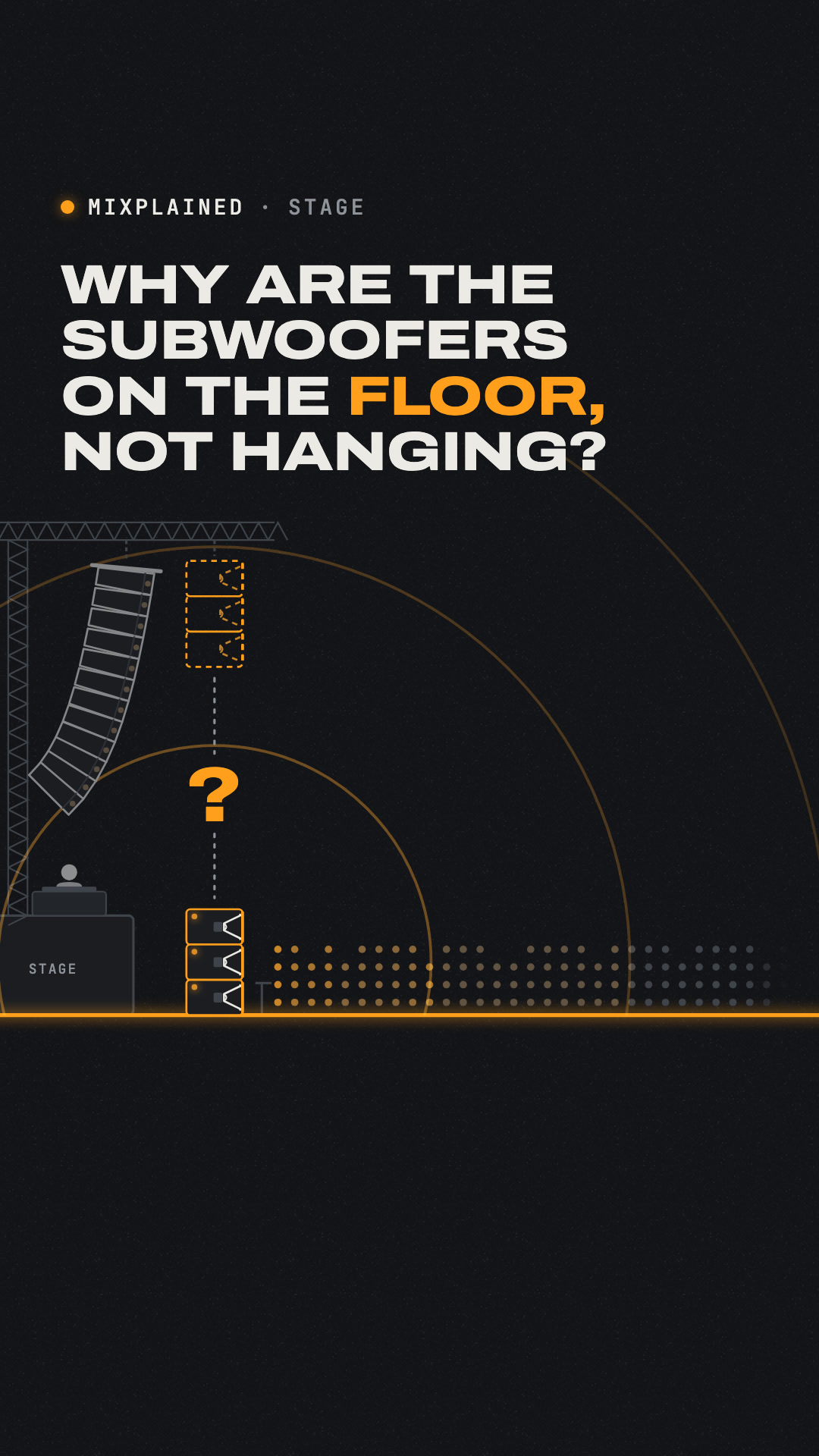
Why festival subwoofers usually sit on the floor: bass waves are so long that the floor acts as a mirror and adds up to about 6 dB, one box often faces backwards to cancel the boom on stage, and big stages hang some subs too for more even bass.
Floor for punch. Air for reach.
Facts
- Bass waves are long – about 10 m at 35 Hz down to 3 m at 120 Hz (d&b), the deepest about as long as a 40-foot shipping container (Merlijn van Veen) – so a floor acts as a mirror: a ground-stacked sub gets an in-phase “virtual” twin, up to about 6 dB louder, the same gain as doubling the boxes. L-Acoustics even quotes its KS28 sub's maximum level under half-space conditions.
- In a cardioid stack, often one box in three faces backwards. It is usually delayed by about the depth of the box (typically 3–5 ms) and polarity-inverted, so behind the stack it cancels the bass the front boxes send back onto the stage. d&b quotes at least 15–20 dB of rear rejection for its Cardioid Subwoofer Array; a lab test of one cardioid sub measured 14–16 dB.
- Directional subs need open air: under a stage, a cardioid sub loses most of its pattern; moved about a metre (3 ft) in front of the stage, it works again (Adam Hill's 2016 research, ProSoundWeb 2026).
- Flown subs even out bass from front to back: in van Veen's modelled example the front-to-back difference falls from 24 dB on the floor (1:16 distance ratio) to 12 dB flown (1:4). Ground stacks get floor coupling for “added horsepower”, but their thump is strongest near the stage. Flying needs more boxes and rigging: d&b's flyable SL-SUB weighs 138 kg and can be flown in columns of up to 14.
- Left and right sub stacks add up fully only along the centre line – the “power alley”, where the bass is noticeably louder – while elsewhere it comes and goes by frequency (in one 100 Hz model, the gaps were 20 dB down). A line of subs across the stage front avoids it and is “the staple in EDM”, but it is less efficient (van Veen).
- End-fire arrays place subs one behind another, each delayed (about 2.9 ms per metre) so they add up in front and cancel behind. Parookaville's 2024 main-stage system flew 36 Meyer Sound 2100-LFC subs in gradient end-fire arrays and ground-stacked 69 1100-LFCs for a 70,000-capacity audience area; van Veen described turning the subs into two big end-fire arrays aimed out in a V, each covering half the crowd, to avoid left-right power alleys.
Sources
- Merlijn van Veen: Low frequency control – transcription of his presentation at the 59th AES International Conference on Sound Reinforcement, Montreal (July 2015) · Merlijn van Veen checked 8 October 2026
- Merlijn van Veen: Which sub to reverse? Pt. 1 (23 July 2017) · Merlijn van Veen checked 8 October 2026
- Merlijn van Veen: Which sub to reverse? Pt. 2 (25 July 2017) · Merlijn van Veen checked 8 October 2026
- d&b audiotechnik: TI 330 – Cardioid Subwoofer Array (CSA), version 1.0E (01/2004), archived copy · d&b audiotechnik checked 8 October 2026
- d&b audiotechnik: SL-SUB subwoofer (product page) · d&b audiotechnik checked 8 October 2026
- d&b audiotechnik: SL-GSUB subwoofer (product page) · d&b audiotechnik checked 8 October 2026
- L-Acoustics: KS28 subwoofer (product page and specifications) · L-Acoustics checked 8 October 2026
- Meyer Sound: 2100-LFC low-frequency control element (product page) · Meyer Sound checked 8 October 2026
- ProSoundWeb: Jerrold Stevens – The Best Place To Put Subwoofers Is… ? (26 June 2018) · ProSoundWeb checked 8 October 2026
- ProSoundWeb: Jim Yakabuski – Bringing The Boom: Main/Sub Array Configurations & Implementation (7 January 2025) · ProSoundWeb checked 8 October 2026
- ProSoundWeb: Jeff Berryman – Subwoofer Arrays: Analysis Of A Variety Of Bass Coverage Patterns (5 February 2025) · ProSoundWeb checked 8 October 2026
- ProSoundWeb: Adam Hill – Counterintuitive? Cardioid Subwoofers Can Be A Bit Claustrophobic (11 September 2026) · ProSoundWeb checked 8 October 2026
- ProSoundWeb: Bob McCarthy – The End Fire Cardioid Subwoofer Array Made Visible (26 April 2019) · ProSoundWeb checked 8 October 2026
- ProSoundWeb: Joe Brusi – The “Power Alley” – AKA, The Troubling Interaction Of Subwoofers (4 March 2024) · ProSoundWeb checked 8 October 2026
- FOH (Front of House) magazine: Annual EDM Festival Welcomes Top DJs and Big Crowds to Small Airport in Germany (November 2024, p. 12; copy hosted by Merlijn van Veen) · FOH magazine checked 8 October 2026
- Wikipedia: Subwoofer · Wikipedia checked 8 October 2026
Example figures: each rig is designed for its stage. Front rows by ground subs get the most bass: earplugs.
All sound is original: synthesised for the episode, no samples, no licensed tracks. The narrator’s voice is AI-generated. General information. Features differ by software, player and version – check your own manual. Read how facts are checked and corrected.
Script
Why are the subwoofers on the floor, not hanging? The deepest bass waves are as long as a shipping container. To a wave that long, the floor is a mirror. It adds a free twin: up to about 6 dB. Why does one box face backwards? Bass spills onto the stage too. It usually plays a few milliseconds late, polarity flipped. Behind the stack, the waves cancel: about 15 dB quieter than out front. But hanging evens out the bass, front to back. Example: 24 dB front to back on the floor. 12 in the air. Parookaville's 2024 main stage did both: 36 subs flown, 69 on the ground. Floor for punch. Air for reach.
Sources last checked 8 October 2026.