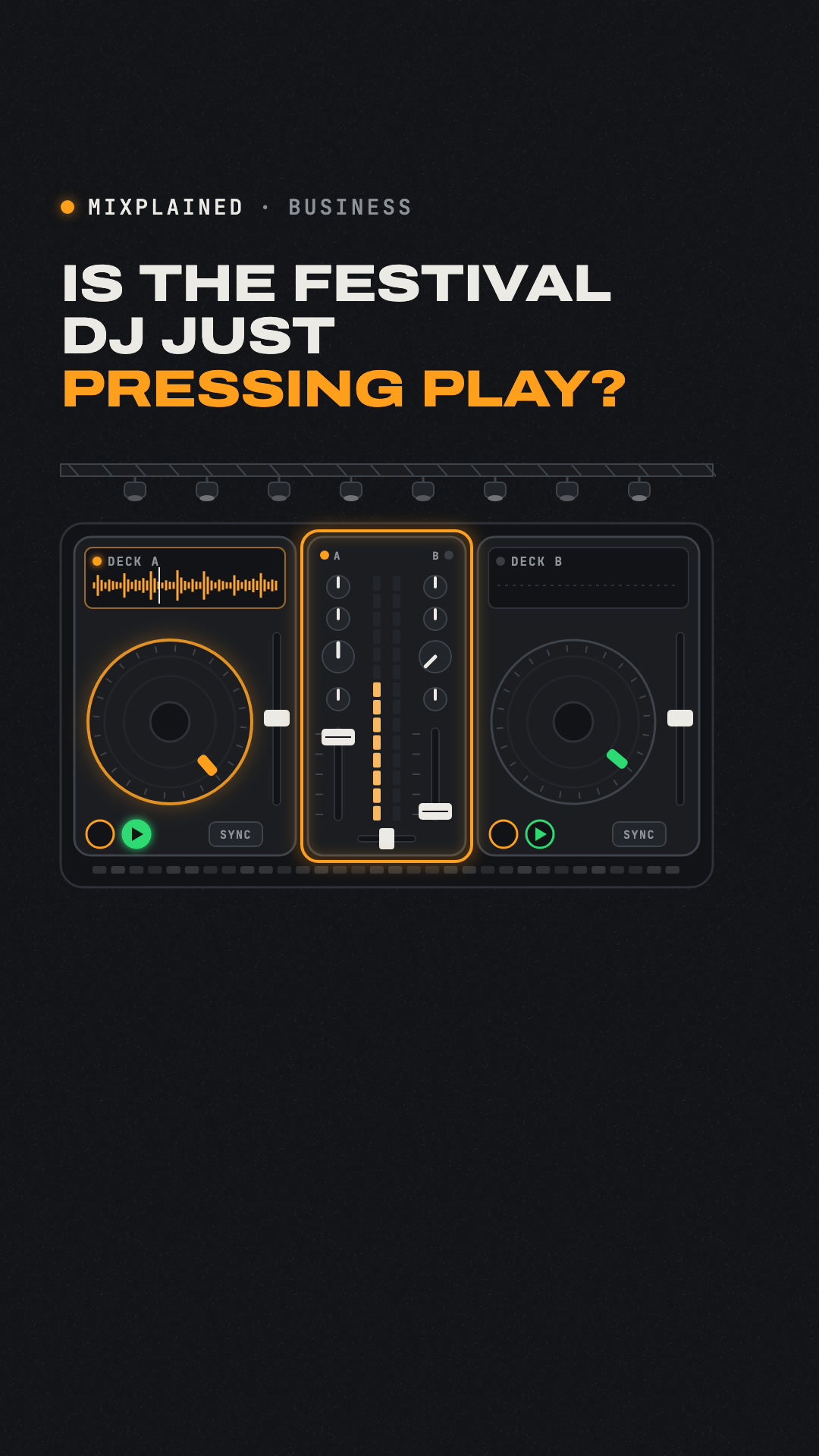
Is the festival DJ just pressing play? Usually not: a DJ set is mixed live. But big stage shows can run to a timecode, and in 2012 deadmau5 explained his own: pre-mixed parts, a set timeline, and the skill in the studio.
DJ sets are usually live; big shows run to timecode, and the craft moves to the studio.
Facts
- A DJ set is usually mixed live: the DJ chooses tracks partly in response to the dance floor, lines up the beats (by ear, or with the software's “sync”, which automates beatmatching) and adjusts each track's volume and tone on the mixer. Using sync is not the same as playing a pre-recorded set.
- Big shows can lock the music to the production. In June 2012 deadmau5 wrote that at his concerts a computer running Ableton Live played “premixed (to a degree) stems” of his own tracks and sent SMPTE timecode to front of house, so the lights and video knew where he was. That kept him “constrained to work on a set timeline”, though he could tweak synths live.
- His post, titled “we all hit play.”, argued that producers' skills “shine … in the studio, and on the … releases”, and that with about an hour of instruction anyone with minimal Ableton knowledge could do what he did at a deadmau5 concert. For DJ sets without the big show, he said he selected tracks on a laptop and let Ableton sync them.
- SMPTE timecode, defined by the Society of Motion Picture and Television Engineers, labels every single frame of film or video; it has been adapted to synchronise music and theatrical production.
- Miming – acting out a live mix while a pre-recorded mix plays – is considered controversial in DJ culture. A 2025 Dancecult article criticises pre-recorded EDM sets synced to fireworks and visuals, and links Saturday Night Live's 2014 sketch “When Will the Bass Drop?”, where a DJ's job is reduced to one oversize BASS button, to deadmau5's remarks.
- Studio mixes can go further than live ones: with more time, studio DJs often make mixes that could never be done in real time.
Sources
- deadmau5: “we all hit play.” (Tumblr post, June 2012; Internet Archive copy of 25 June 2012) · deadmau5 checked 9 October 2026
- Rolling Stone: Deadmau5 clarifies 'press play' comments about fellow DJs (25 June 2012; Internet Archive copy) · Rolling Stone checked 9 October 2026
- MusicRadar: Deadmau5 – “we all hit play” (Si Truss, 25 June 2012) · MusicRadar checked 9 October 2026
- Wikipedia: DJ mix · Wikipedia checked 9 October 2026
- Wikipedia: Disc jockey · Wikipedia checked 9 October 2026
- Wikipedia: SMPTE timecode · Wikipedia checked 9 October 2026
- Davis, Callander & Haberfeld: On the spectrum – where is EDM placed within electronic dance music culture? (Dancecult 17/1, 2025) · Dancecult checked 9 October 2026
All sound is original: synthesised for the episode, no samples, no licensed tracks. The narrator’s voice is AI-generated. General information. Features differ by software, player and version – check your own manual. Read how facts are checked and corrected.
Script
Is the festival DJ just pressing play? Usually not. The DJ picks the next track, lines up the beats, by ear or with sync, and shapes the sound. But big stage shows can be planned to the second: the lights, video and fire follow the music. In 2012, deadmau5 explained his own show in a blog post: “We all hit play.” A computer played pre-mixed parts of his tracks. A timecode told the lights and video where he was. He could tweak synths live, but the timecode held him to a set timeline. His skill, he wrote, shines in the studio. Learning to run the show, he reckoned: about an hour.
Sources last checked 9 October 2026.