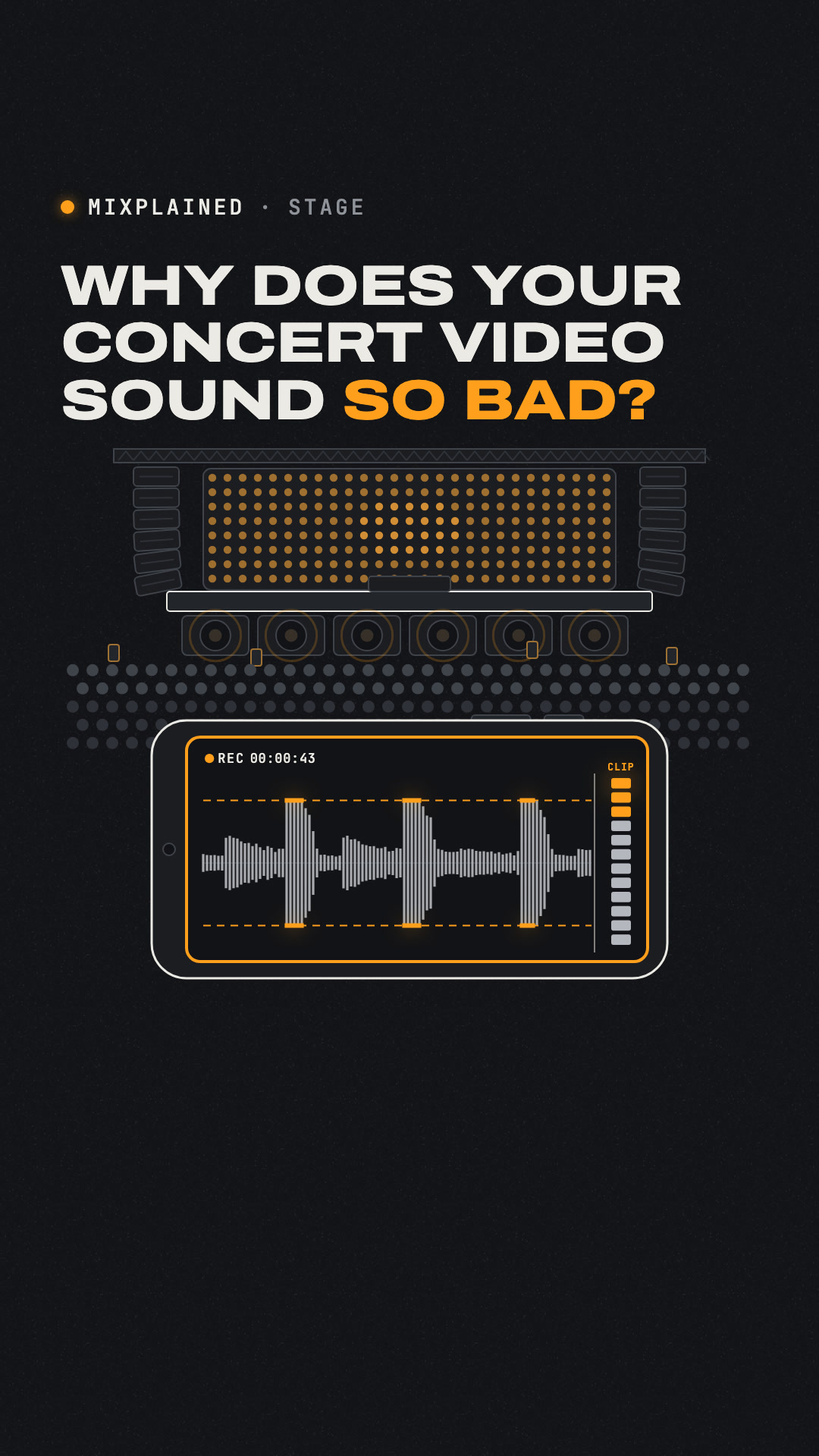
Why phone videos of gigs sound clipped, pumping and thin: front-row peaks can top 140 dB, phone mic chips hit 10 % distortion around 120–130 dB, and auto gain and wind filters squash the drop and cut the bass.
Tuned for voices. Not for the drop.
Facts
- How loud a show is: one Amsterdam festival averaged 100 dBA over a 4½-hour visit (JAMA Otolaryngology, 2016), and WHO's venue standard caps the 15-minute average at 100 dB. In monitoring data from more than 300 shows, the front row peaked above 140 dBC (5-minute averages 120–130 dBC) where the subwoofers stood on the ground.
- Phone mics are usually MEMS chips a few millimetres wide (for example 3.50 × 2.65 × 0.98 mm). Datasheets put the acoustic overload point – where distortion reaches 10 % – at 120 dB SPL (Knowles SPH0645), 130 (Infineon IM69D130) and 133 (TDK T5838, aimed at smartphones); NIOSH researchers give 120 to 130 dB SPL for MEMS mics.
- Past that point the peaks clip: on these digital mics, full scale sits at about the overload point (94 dB SPL plus the sensitivity, e.g. 94 + 26 = 120; computed). Infineon lists “recordings in a discotheque or at a rock concert” as a use case for its high-overload chip, which stays under 1 % distortion up to 128 dB SPL.
- Phones process what they record. Android's own example setup puts automatic gain control on video recording, tuned for “far-talk” speech; AGC keeps the output “virtually constant”, so music's loud parts go down, quiet parts go up, and a regular kick can make the whole mix pump. iOS adds “appropriate audio-signal processing” to video recording; its measurement mode turns some dynamics processing off.
- Filters thin the bass. Wind noise is mostly low-frequency, and on Shure's MV88 phone mic the Wind Reduction switch adds high-pass filtering. iPhone 16 and later reduce wind noise automatically when filming in Spatial Audio or Stereo, unless you turn Wind Noise Reduction off. Early iPhones had a high-pass filter that NIOSH researchers say degraded measurements.
- Android's compatibility rules check phone mics for under 1 % distortion at 90 dB SPL, and define an optional “unprocessed” source with no auto gain, high-pass filter or echo cancelling. What helps: step back from the front (about −6 dB per doubling of distance from a point source) and use a camera app with a manual audio level, peaks in the green.
Sources
- Adam Hill: Live event sound levels – rising above the “insidious undercurrent of aural incapacitance” (ProSoundWeb, 29 Dec 2022) · ProSoundWeb checked 8 October 2026
- Ramakers et al.: Effectiveness of earplugs in preventing recreational noise-induced hearing loss – a randomized clinical trial (JAMA Otolaryngology–Head & Neck Surgery, 2016) · JAMA Otolaryngology checked 8 October 2026
- WHO: WHO hearing guidelines implemented at major arts festival (feature story, 8 Oct 2024) · WHO checked 8 October 2026
- Wikipedia: Microphone (MEMS; windscreens) · Wikipedia checked 8 October 2026
- TDK InvenSense: T5838 bottom-port PDM digital-output multi-mode microphone – product key details · TDK InvenSense checked 8 October 2026
- Knowles: SPH0645LM4H-B I2S output digital microphone datasheet, Rev B (hosted by Adafruit) · Knowles checked 8 October 2026
- Infineon: IM69D130 high performance digital XENSIV MEMS microphone – datasheet v1.0 · Infineon checked 8 October 2026
- Kardous & Shaw (NIOSH): Evaluation of smartphone sound measurement applications (J. Acoust. Soc. Am. 135(4), EL186, 2014) · JASA checked 8 October 2026
- Kardous & Shaw (NIOSH): Evaluation of smartphone sound measurement applications (apps) using external microphones – a follow-up study (J. Acoust. Soc. Am. 140(4), EL327, 2016) · JASA checked 8 October 2026
- Wikipedia: Clipping (audio) · Wikipedia checked 8 October 2026
- Android Developers: AutomaticGainControl (android.media.audiofx) · Android Developers checked 8 October 2026
- Android Open Source Project: Configure pre-processing effects · Android checked 8 October 2026
- Apple Developer: AVAudioSession.Mode.videoRecording · Apple checked 8 October 2026
- Apple Developer: AVAudioSession.Mode.measurement · Apple checked 8 October 2026
- Wikipedia: Automatic gain control · Wikipedia checked 8 October 2026
- Wikipedia: Dynamic range compression · Wikipedia checked 8 October 2026
- Sound On Sound: Shure MV88 digital stereo condenser microphone for iOS (Tom Flint, April 2016) · Sound On Sound checked 8 October 2026
- Apple Support, iPhone User Guide: Change sound recording options on iPhone · Apple checked 8 October 2026
- Android 17 Compatibility Definition Document: 5.4.2 Capture for voice recognition; 5.11 Capture for unprocessed · Android checked 8 October 2026
- Android Developers: MediaRecorder.AudioSource · Android Developers checked 8 October 2026
- Open Camera: Help – video settings, Audio source · Open Camera checked 8 October 2026
- Blackmagic Design: Blackmagic Camera app (iOS and Android) · Blackmagic Design checked 8 October 2026
- Sound On Sound: Line arrays explained (David Mellor, March 2006) · Sound On Sound checked 8 October 2026
- Sound On Sound: Live side-chain compression (Len Sasso, August 2010) · Sound On Sound checked 8 October 2026
Results vary by phone and app; no setting rescues a mic chip past its limit. Near the subs, wear earplugs.
All sound is original: synthesised for the episode, no samples, no licensed tracks. The narrator’s voice is AI-generated. General information. Features differ by software, player and version – check your own manual. Read how facts are checked and corrected.
Script
Why does your concert video sound so bad? You heard this. Festivals can average 100 dB. Up front, peaks can top 140. Your phone's mic is usually a tiny chip. Chips like it hit 10% distortion around 120 to 130 dB. Past that, peaks get sliced off. Then the phone tries to help. Auto gain, often tuned for speech, turns loud bits down, quiet bits up. Each kick can duck the mix: a pump, by accident. And filters against wind rumble can thin the bass. Cleaner? Step back, and set your own level in a pro camera app. Tuned for voices. Not for the drop.
Sources last checked 8 October 2026.