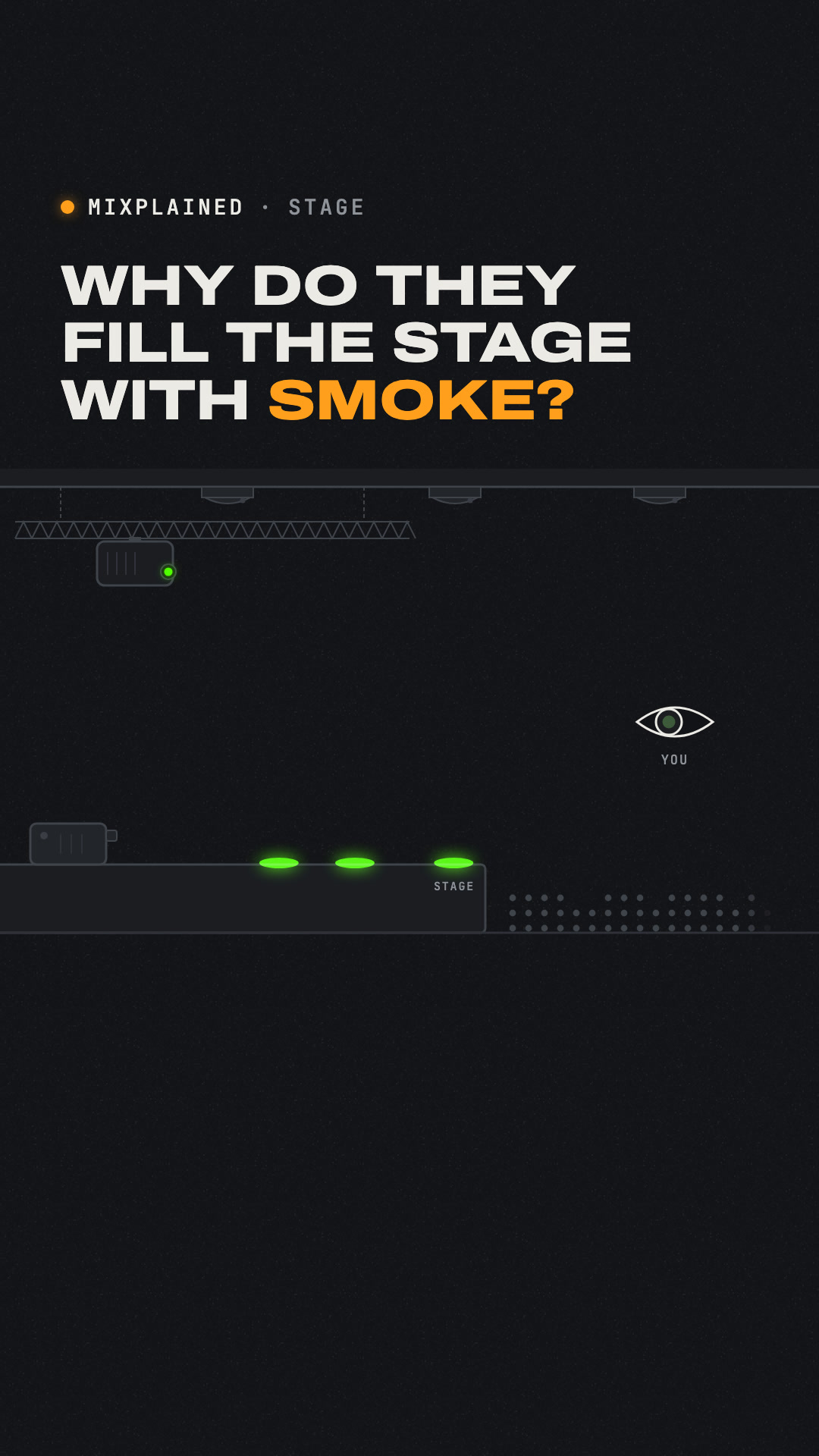
Why stages fill with “smoke”: it is usually haze, a mist of droplets around a thousandth of a millimetre that scatters light toward your eye so the beams show – the same trick optical smoke detectors use, so venues may isolate them under a fire watch.
The haze is the screen. The light is the show.
Facts
- In clean air a light beam is nearly invisible from the side: you only see light that reaches your eye, so the beam needs particles to scatter some of it your way. The effect is named after John Tyndall, whose 1869 tube at the Royal Institution showed a beam turning blue from the side as he filled it with smoke. ILDA says almost all professional beam shows need a hazer or fog machine, at least indoors.
- Stage “smoke” for beams is usually haze: a fine mist of a water-based fluid (glycols or glycerin) or white mineral oil that is often unnoticeable to the audience, spreads evenly and hangs for a long time. Measured oil-haze droplets were 0.1–1 µm (Mount Sinai/ENVIRON, 2000); MDG specifies 0.5–0.7 µm for its ATMe hazer.
- Hazers sip fluid: Le Maitre rates its Neutron at 100–120 hours of haze from one 2.5-litre bottle, and Look Solutions its Unique 2.1 at up to 50 hours from 2 litres. Haze builds slowly, so crews start it before the lights.
- Fog is thicker and comes in bursts: heated glycol vapour condenses into droplets, and in a Broadway study bursts of 5–15 seconds had cleared to below detection within 8–10 minutes. Low fog is chilled – dry ice, liquid CO₂ or liquid nitrogen – so it is heavier than air and hugs the floor; HSE warns CO₂ can pool in orchestra pits.
- Optical smoke detectors work by scattering too: a light in a dark chamber points away from a sensor until particles scatter it in. Haze can trip them, so UK fire-safety guidance says detectors near the stage may be isolated – limited in area and time, back on once the smoke has passed – and ILDA describes a fire watch instead.
- HSE guidance says audience exposure to smoke and vapour effects should be kept to the minimum, with warnings; the 2000 Broadway study recommended peaks no higher than 40 mg/m³ for glycols and 25 mg/m³ for mineral oil, and ESTA's ANSI E1.5 and E1.23 standards cover fog fluids and effect design.
Sources
- International Laser Display Association: Haze and fog for laser shows · ILDA checked 8 October 2026
- HyperPhysics (Georgia State University, R. Nave): Blue Sky, Rayleigh and Mie Scattering · HyperPhysics checked 8 October 2026
- Wikipedia: Tyndall effect · Wikipedia checked 8 October 2026
- Royal Institution: John Tyndall's blue sky apparatus (1869) · Royal Institution checked 8 October 2026
- Mount Sinai School of Medicine and ENVIRON: Health Effects Evaluation of Theatrical Smoke, Haze, and Pyrotechnics (6 June 2000, for the Equity-League Pension and Health Trust Funds) · Mount Sinai/ENVIRON checked 8 October 2026
- MDG: ATMe haze generator (product page and specifications) · MDG checked 8 October 2026
- MDG: Fluids · MDG checked 8 October 2026
- ESTA Technical Standards Program: published documents – ANSI E1.5-2009 (R2024) and ANSI E1.23-2023 · ESTA checked 8 October 2026
- Look Solutions: Unique 2.1 haze generator, information sheet · Look Solutions checked 8 October 2026
- Look Solutions: Unique 2.1 operating manual · Look Solutions checked 8 October 2026
- Look Solutions: product catalogue (11/2024) – Cryo-Fog low fog system · Look Solutions checked 8 October 2026
- MDG: ICE FOG Q low fog generator · MDG checked 8 October 2026
- Le Maitre: Neutron hazer · Le Maitre checked 8 October 2026
- HSE: Smoke and vapour effects used in entertainment, Entertainment Information Sheet No 3, ETIS3(rev2), 09/17 · HSE checked 8 October 2026
- HM Government (Home Office): Fire safety risk assessment – theatres, cinemas and similar premises (2006, page updated 2023) · Home Office checked 8 October 2026
- Wikipedia: Smoke detector (photoelectric) · Wikipedia checked 8 October 2026
- Wikipedia: Haze machine · Wikipedia checked 8 October 2026
Bringing a hazer to a gig? Ask the venue first: detectors are isolated only under its fire plan.
All sound is original: synthesised for the episode, no samples, no licensed tracks. The narrator’s voice is AI-generated. General information. Features differ by software, player and version – check your own manual. Read how facts are checked and corrected.
Script
Why do they fill the stage with smoke? In clean air, the beam nearly vanishes. You only see light that reaches your eye. So crews pump in haze: not smoke, but droplets about a thousandth of a millimetre. Each droplet scatters a little light your way. The beam appears. Fog comes in thick bursts that clear in minutes. Haze is often too fine to notice, and it hangs. The catch: optical smoke detectors use the same trick, a light waiting for particles to scatter it. So venues may isolate detectors near the stage, and someone keeps fire watch. The haze is the screen. The light is the show.
Sources last checked 8 October 2026.