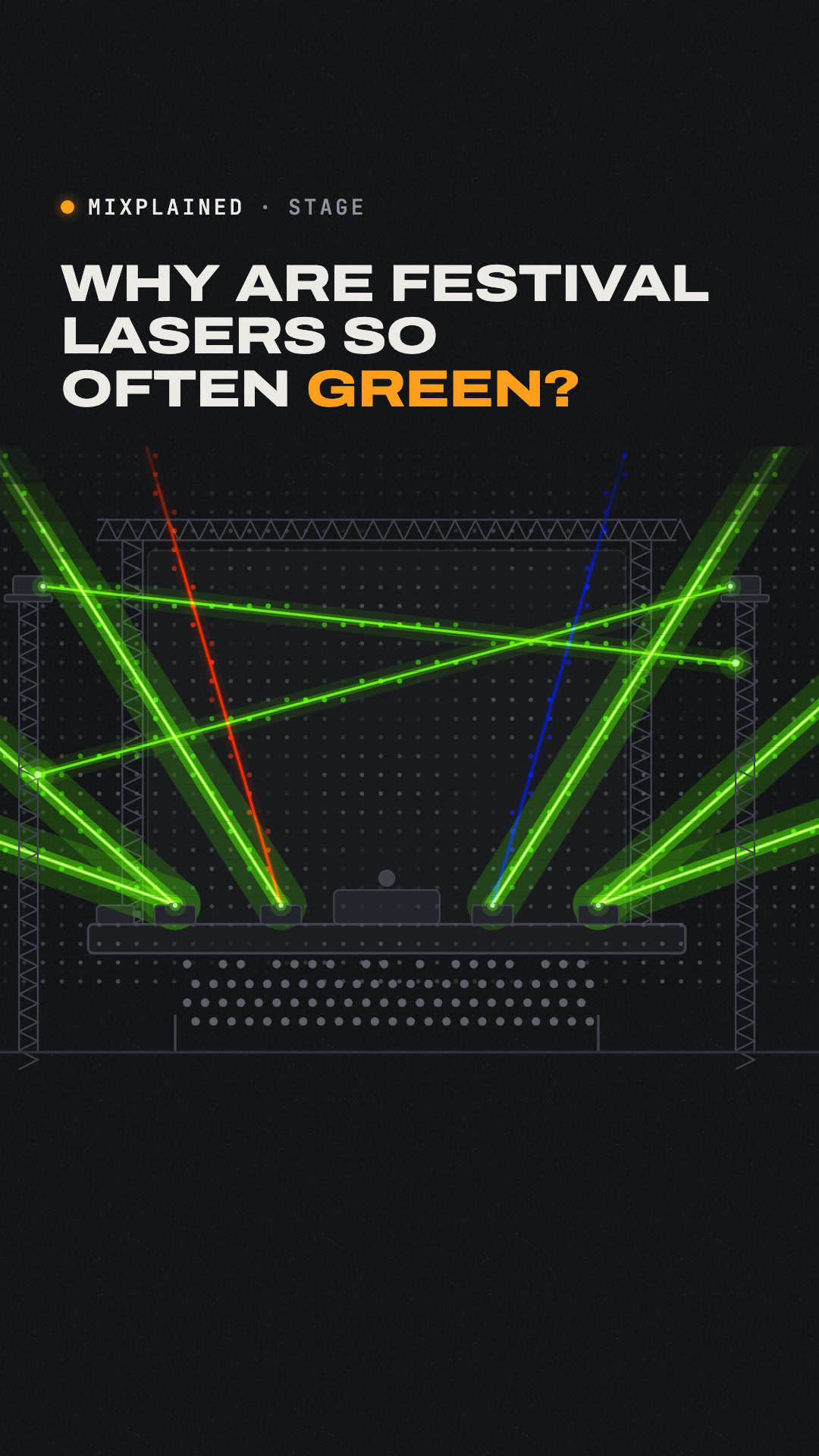
Why festival lasers are so often green: the eye is most sensitive near 555 nm, so at the same power a green beam looks about four times brighter than red and up to 30 times brighter than blue – even when blue gets the biggest share of a projector's watts.
Lasers don't love green. Your eyes do.
Facts
- The eye is most sensitive around 555 nm, in the green. On the CIE's standard daylight curve V(λ), a watt of 532 nm green counts 0.88, 635 nm red 0.22 and 445 nm blue 0.03. The UK Health Security Agency puts the perceived brightness of equal-power lasers at 670, 635, 532 and 445 nm at roughly 1 : 7 : 30 : 1 – green about four times red and up to 30 times blue. (The standard curve is known to underrate blue; a newer CIE curve gives about 15×.)
- A white laser beam needs more red and blue watts than green. Pangolin calls 40–50 % blue – “the cheapest source” – part of a good RGB balance. In one ILDA member's white mix (1.4 : 1 : 1.6 at 637, 532 and 450 nm), blue is 40 % of the watts but about 5 % of the brightness, and green 25 % of the watts but about 72 % of the brightness (computed with V(λ)).
- Argon-ion gas lasers, blue and green, were the backbone of laser shows from the 1970s to the 1990s. Then diode-pumped solid-state lasers made the 532 nm greens that became iconic: an 808 nm diode pumps a crystal that lases at invisible 1064 nm infrared, and a second crystal halves the wavelength. NIST found one cheap green pointer leaking 20 mW of infrared.
- Nichia and OSRAM began making high-power green laser diodes (515/520 nm) in 2012; diode lasers now dominate professional show lasers.
- Pangolin suggests 40 W and more for large festivals. In the US, show lasers above 5 mW need an FDA variance; beams above Class I must stay at least 3 m above any floor the audience stands on and 2.5 m to the side of it, and any laser light that reaches the audience must be below Class I.
- Where audiences are scanned, exposure must stay below the maximum permissible exposure (MPE), which ILDA says is essentially the same worldwide: operators widen the beam or cut the power, and measure with a meter. Beams only show where particles scatter the light, so almost all professional beam shows use haze or fog, at least indoors.
Sources
- UK Health Security Agency: Laser radiation – safety advice (published May 2006, revised February 2025) · UKHSA checked 8 October 2026
- CIE: Spectral luminous efficiency for photopic vision, V(λ) (dataset, from CIE 018:2019 Table 1; DOI 10.25039/CIE.DS.dktna2s3) · CIE checked 8 October 2026
- International Laser Display Association: Laser projector specifications · ILDA checked 8 October 2026
- Pangolin Laser Systems: What is a Laser Show Projector? (Justin Perry, March 2026) · Pangolin checked 8 October 2026
- Pangolin Laser Systems: What is Laser Light? Everything You Need To Know (Justin Perry, May 2026) · Pangolin checked 8 October 2026
- Pangolin Laser Systems: Which Laser Show Projector Is Right for You? Buyer's Guide (Justin Perry, March 2026) · Pangolin checked 8 October 2026
- NIST: SI Redefinition – Candela · NIST checked 8 October 2026
- Wikipedia: Luminous efficiency function · Wikipedia checked 8 October 2026
- Wikipedia: Laser pointer · Wikipedia checked 8 October 2026
- Wikipedia: Diode-pumped solid-state laser · Wikipedia checked 8 October 2026
- Galang, Restelli, Hagley & Clark (NIST): A Green Laser Pointer Hazard (arXiv:1008.1452, 2010) · NIST checked 8 October 2026
- US Food and Drug Administration: Laser Light Shows (updated 18 April 2023) · FDA checked 8 October 2026
- FDA Form 3640 (08/26): Reporting Guide for Laser Light Shows and Displays · FDA checked 8 October 2026
- FDA Form 3147 (04/24): Application for a Variance from 21 CFR 1040.11(c) for a Laser Light Show, Display, or Device · FDA checked 8 October 2026
- International Laser Display Association: How to do safe audience scanning · ILDA checked 8 October 2026
- PD IEC TR 60825-3:2022 Safety of laser products – Guidance for laser displays and shows (BSI, 31 Aug 2022) · BSI checked 8 October 2026
- International Laser Display Association: Haze and fog for laser shows · ILDA checked 8 October 2026
Show lasers are Class 4: trained operators only. Never aim any laser at people or aircraft.
All sound is original: synthesised for the episode, no samples, no licensed tracks. The narrator’s voice is AI-generated. General information. Features differ by software, player and version – check your own manual. Read how facts are checked and corrected.
Script
Why are festival lasers so often green? Three beams, same power: one watt each. It's your eye: most sensitive near 555 nanometres, in the green. Watt for watt, green looks about 4 times brighter than red, and up to 30 times brighter than blue. The twist: in a typical white mix, blue gets the most watts, yet makes only about 5 % of what you see. Festival lasers can top 40 watts, so any beam that reaches the crowd must be measured and turned down. And in clear air the beams disappear. No haze, no beam. Lasers don't love green. Your eyes do.
Sources last checked 8 October 2026.