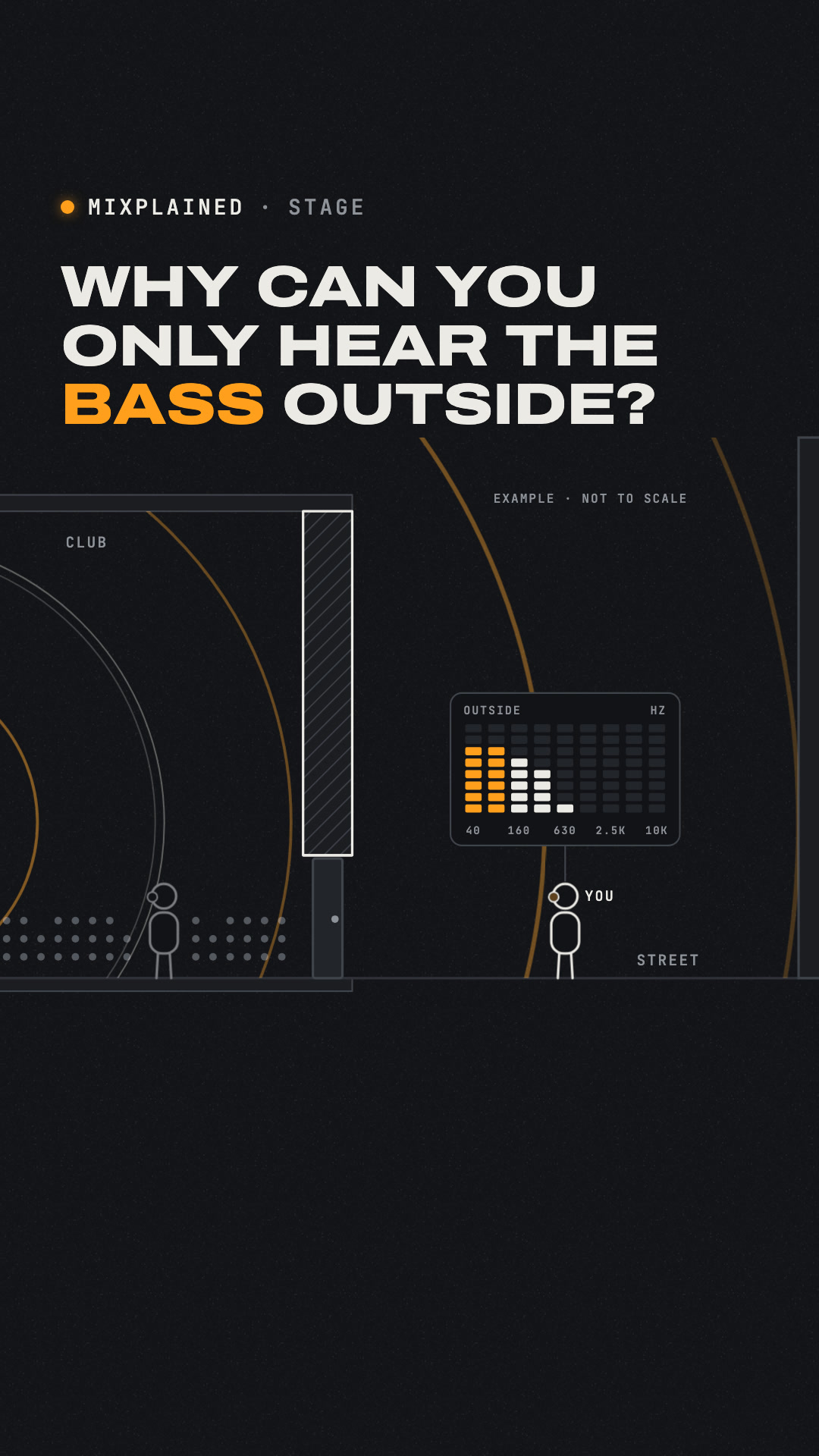
Why only the bass gets out of a club: a solid wall blocks about 6 dB more each time the pitch doubles, open doors and cracks leak the highs, wall ratings start above most of a kick's energy, and long bass waves bend round corners.
The wall keeps the hats. The street gets the bass.
Facts
- A solid wall stops high frequencies far better than low ones. NRC Canada's “mass law” for a single layer is TL ≈ 20 log10(mass per m² × frequency) − 48 dB, so each doubling of the frequency or the mass adds about 6 dB. Sound On Sound explains it as inertia – shaking a wall a thousand times a second takes far more energy than 20 times – and calls it the reason you hear “the bass and kick drum but little else” outside a nightclub.
- Example, computed with the mass law (idealised): 10 cm of dense concrete weighs about 230 kg/m² and blocks about 31 dB at 40 Hz but about 71 dB at 4 kHz – 40 dB more on the highs. Real walls dip below the mass law at some frequencies, and cracks around doors and windows cut the insulation most in the high bands.
- Standard wall ratings start around 100 Hz: the ISO weighted sound reduction index (Rw) uses bands from 100 to 3150 Hz, the US STC from 125 to 4000 Hz, while most of a kick drum's energy sits at 50–100 Hz. The WHO notes these ratings suit indoor noises without strong low frequencies; STC is “useful for evaluating annoyance due to speech sounds, but not music”.
- Sound travels about 343 m/s at 20 °C, so a 40 Hz wave is about 8.6 m long and a 4 kHz wave about 8.6 cm (computed: wavelength = speed ÷ frequency). Longer waves diffract around corners and barriers far better, so buildings and barriers shield the highs more than the bass.
- Air filters over distance too: by the ISO 9613-1 method, air at 20 °C and 70 % humidity absorbs about 0.1 dB per kilometre at 63 Hz but about 23 dB per kilometre at 4 kHz (computed). A review for the UK's Defra notes that noise which has travelled far “is normally biased towards the low frequencies”.
- Noise meters and ears both discount bass. The usual A-weighting counts 63 Hz about 26 dB and 40 Hz about 35 dB quieter, and the WHO says A-weighted measures are inappropriate when prominent low frequencies are present. To the ear, 50 Hz at 79 dB sounds about as loud as 3 kHz at 54 dB (NRC Canada).
Sources
- Sound On Sound: Practical soundproofing – how to keep sound in & out of your studio (Paul White, 2008) · Sound On Sound checked 8 October 2026
- Sound On Sound: Practical studio soundproofing, part 1 (Paul White, 1998) · Sound On Sound checked 8 October 2026
- NRC Canada, Canadian Building Digest 239: Factors affecting sound transmission loss (A.C.C. Warnock, 1985) · NRC Canada checked 8 October 2026
- NRC Canada, Canadian Building Digest 236: Introduction to building acoustics (A.C.C. Warnock, 1985) · NRC Canada checked 8 October 2026
- NRC Canada, Canadian Building Digest 240: Sound transmission through windows (J.D. Quirt, 1988) · NRC Canada checked 8 October 2026
- HyperPhysics: Diffraction of sound (R. Nave, Georgia State University) · HyperPhysics checked 8 October 2026
- FHWA Noise Barrier Design Handbook, 3: Acoustical considerations · FHWA checked 8 October 2026
- University Physics Volume 1, 17.2 Speed of Sound · OpenStax checked 8 October 2026
- Sound On Sound: Live side-chain compression (Len Sasso, 2010) · Sound On Sound checked 8 October 2026
- Wikipedia: Sound transmission class · Wikipedia checked 8 October 2026
- Wikipedia: Sound reduction index · Wikipedia checked 8 October 2026
- WHO: Guidelines for Community Noise (1999), 2. Noise sources and their measurement · WHO checked 8 October 2026
- WHO: Guidelines for Community Noise (1999), 4. Guideline values · WHO checked 8 October 2026
- Leventhall: A review of published research on low frequency noise and its effects (report for Defra, 2003) · Defra checked 8 October 2026
- NPL Acoustics: Calculation of absorption of sound by the atmosphere (ISO 9613-1) · NPL checked 8 October 2026
Example wall and figures: real walls dip below the mass law, and doors, windows and vents leak.
All sound is original: synthesised for the episode, no samples, no licensed tracks. The narrator’s voice is AI-generated. General information. Features differ by software, player and version – check your own manual. Read how facts are checked and corrected.
Script
Why can you only hear the bass outside? Inside, it's the full mix. But a solid wall stops highs far better than lows: about 6 dB more each time the pitch doubles. Inertia: fast highs barely move a heavy wall. Slow bass shakes it, and the wall plays it outside. Open the door, and the hats come straight back. The twist: standard wall ratings start around 100 hertz. A kick's energy is mostly 50 to 100. They're built for speech. Outside, bass waves are huge – about 8.6 metres at 40 hertz – so they bend round corners. The wall keeps the hats. The street gets the bass.
Sources last checked 8 October 2026.