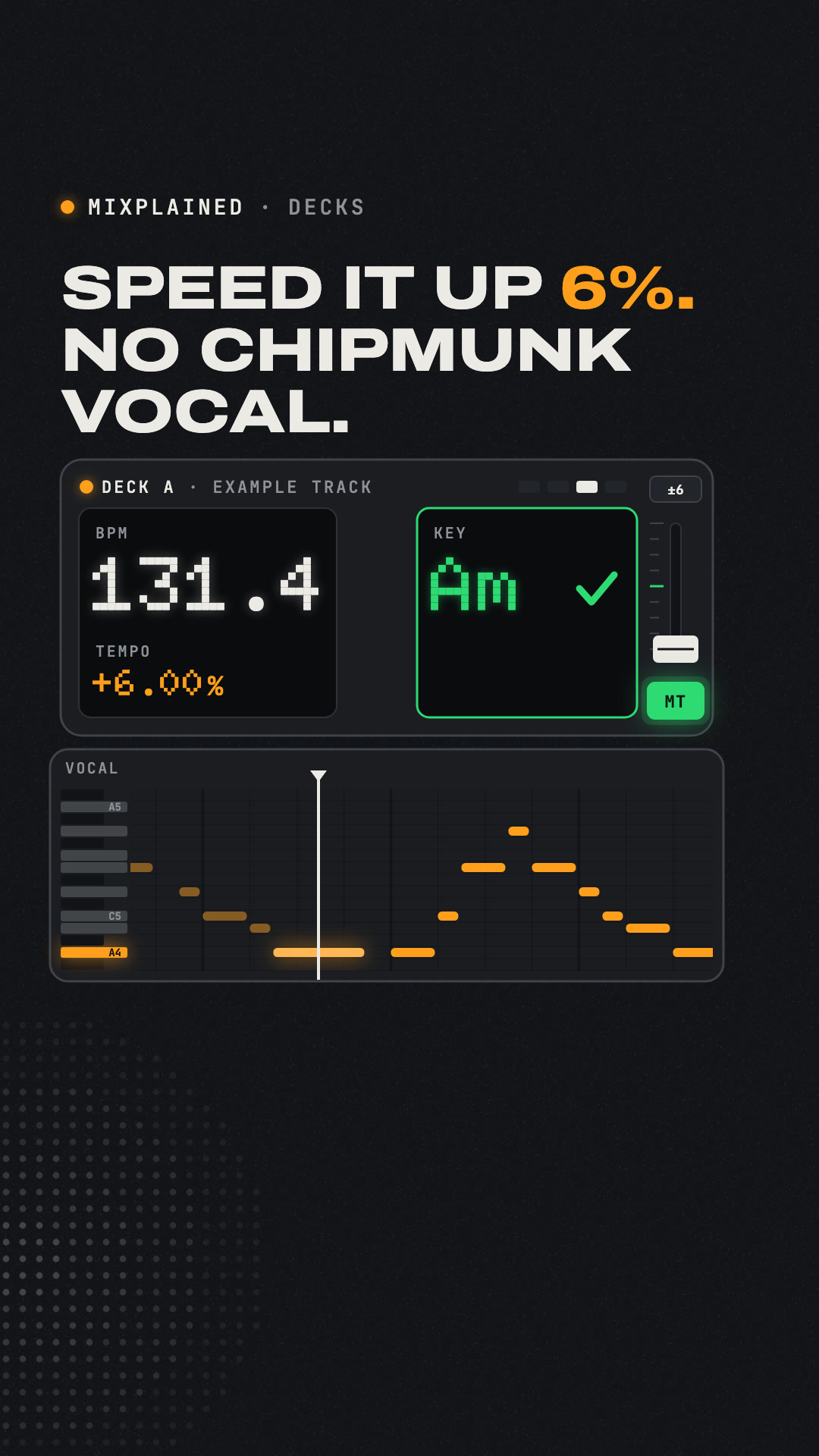
Key lock (Master Tempo): speed a track up 6% and it stays in key. How time-stretching splits tempo from pitch, why Pioneer's first CDJ already had it in 1994, and why big key shifts bring the chipmunk back.
Speed and pitch shared one fader. Key lock split them.
Facts
- On a turntable, or any plain speed change, tempo and pitch move together: every frequency scales with the speed. +6% lifts a track about one semitone (a semitone is a ratio of 2^(1/12) ≈ 1.0595, so +5.95%, computed). Double the speed and it's an octave – the tape trick behind the Chipmunks' voices.
- Key lock time-stretches the audio: it cuts the sound into short slices, often 50–100 ms, and moves them closer together or further apart, so the tempo changes and the pitch doesn't. Pioneer CDJs and rekordbox call it Master Tempo; Serato says Keylock; Traktor and Denon DJ say Key Lock.
- Pioneer's first DJ CD player, the CDJ-500 (June 1994), already had a Master Tempo button. Its manual explains why: on the ±10% tempo control, “the pitch of playback also changes, and vocals become unnatural.”
- The same processing also works the other way round: it changes the key and keeps the tempo. The CDJ-3000's Key Shift moves the key a semitone per press, and Key Sync shifts it to match the track on the sync master.
- It isn't free. rekordbox warns that “the sound quality may change because the sound is digitally reprocessed”, and extreme stretches add artefacts, especially on vocals. Traktor recommends transposing no more than two semitones; push a voice up several and it can sound like a chipmunk again, because its formants move too.
Sources
- AlphaTheta (Pioneer DJ): CDJ-3000 instruction manual (DRI1586-A) · AlphaTheta checked 7 October 2026
- Pioneer: CDJ-500 operating instructions (1994; scanned copy, Internet Archive) · Pioneer checked 7 October 2026
- Pioneer: CDJ-500 service manual (May 1994; scanned copy, Internet Archive) · Pioneer checked 7 October 2026
- AlphaTheta: Company – History · AlphaTheta checked 7 October 2026
- Native Instruments: Traktor Pro manual – Global concepts (Key Lock and color-coding) · Native Instruments checked 7 October 2026
- Native Instruments: Traktor Pro manual – Basic usage tutorials (Working with Key Lock) · Native Instruments checked 7 October 2026
- Serato DJ Pro manual: Keylock (archived copy of 12 Oct 2025; the live page blocks automated readers) · Serato checked 7 October 2026
- AlphaTheta: rekordbox instruction manual (ver. 7.2.18) · rekordbox checked 7 October 2026
- Denon DJ: SC6000/SC5000 Prime user guide (v5.0.0) · Denon DJ checked 7 October 2026
- Driedger & Müller: A review of time-scale modification of music signals (Applied Sciences, 2016) · Applied Sciences checked 7 October 2026
- Wikipedia: Audio time stretching and pitch scaling · Wikipedia checked 7 October 2026
- Wikipedia: Semitone · Wikipedia checked 7 October 2026
- Wikipedia: Alvin and the Chipmunks – Recording technique · Wikipedia checked 7 October 2026
- Wikipedia: CDJ – CDJ-500 · Wikipedia checked 7 October 2026
- Sound On Sound: Time-stretching – Cubase tips & techniques (John Walden, September 2007) · Sound On Sound checked 7 October 2026
Keep shifts small: Traktor recommends transposing two semitones at most.
All sound is original: synthesised for the episode, no samples, no licensed tracks. The narrator’s voice is AI-generated. General information. Features differ by software, player and version – check your own manual. Read how facts are checked and corrected.
Script
Speed it up 6%. No chipmunk vocal. On a turntable, speed and pitch are tied: plus 6% is about a semitone up. Key lock, Master Tempo on a CDJ, cuts that tie: faster beat, same note. It chops the sound into tiny slices and packs them tighter. Pioneer's first CDJ already had it in 1994. The manual's reason: otherwise, “vocals become unnatural.” Key shift does the reverse: a semitone per press, tempo untouched. Push a vocal up several semitones and the chipmunk can creep back: Traktor advises two at most. Speed and pitch shared one fader. Key lock split them.
Sources last checked 7 October 2026.