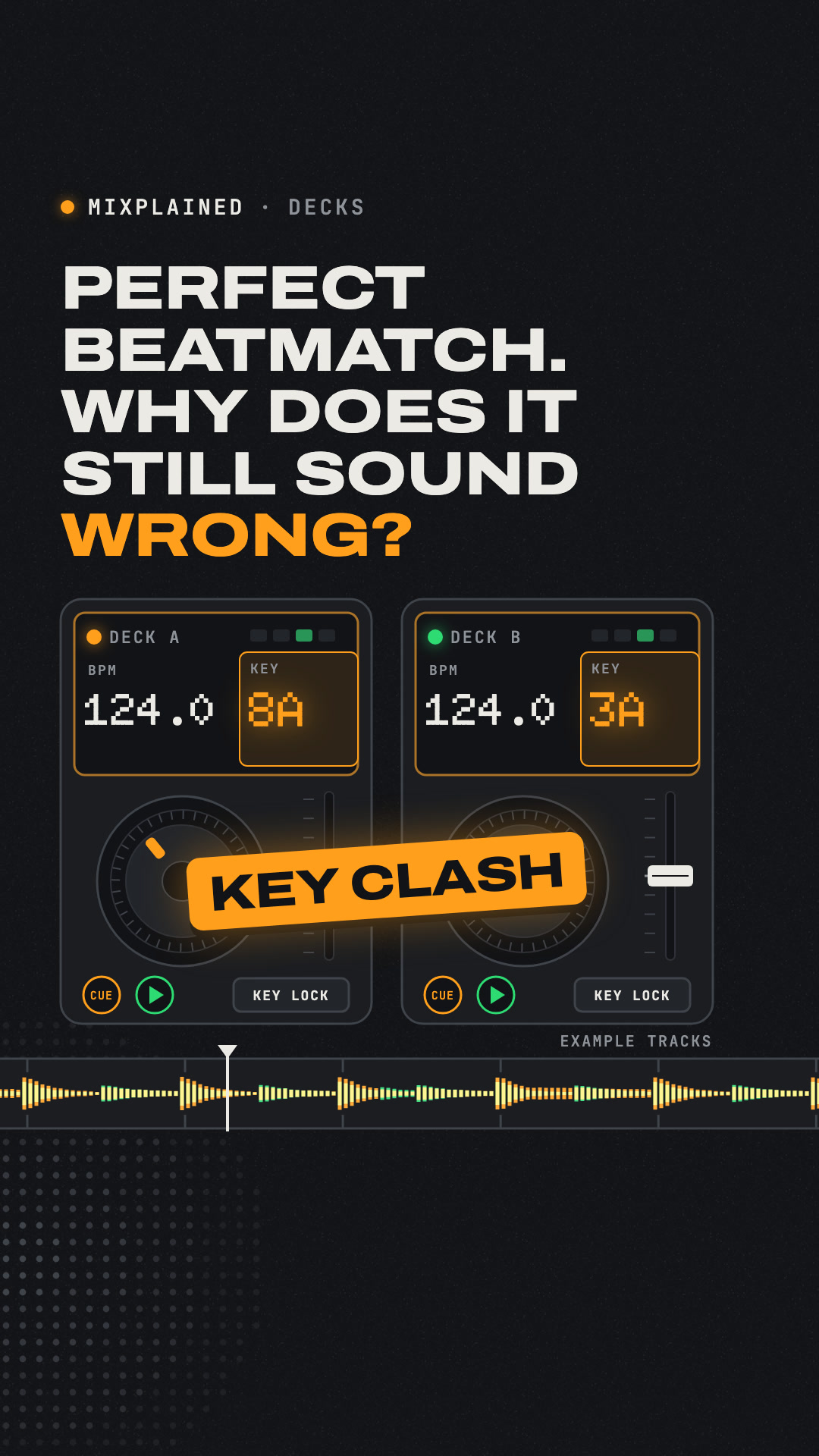
Harmonic mixing: why two perfectly beatmatched tracks can still clash, how the Camelot wheel (8A, 9A, 8B…) finds keys that fit, and how a 6 % tempo push without key lock knocks a track out of key.
Match the beat. Then match the key.
Facts
- Two tracks can be beatmatched perfectly and still clash when their keys don't fit. DJ Mark Davis remembered 1980s mixes that “sounded poor no matter how tightly tracks were beatmatched”. A minor and B♭ minor share only two of their seven scale notes (computed).
- The Camelot wheel puts the 24 major and minor keys on a 12-hour clock: A on the inner ring for minor, B on the outer ring for major (8A = A minor, 8B = C major). Mark Davis drew the clock idea in 1991; Mixed In Key builds its key results on it.
- The basic moves: stay on the same code, move one number either way, or swap A and B – from 8A that's 8A, 7A, 9A or 8B. Keys next to each other on the circle of fifths share six of their seven notes; A and B with the same number share all seven.
- Without key lock (Pioneer calls it Master Tempo), changing the tempo changes the pitch: speeding a track up about 6 % raises it about a semitone (2^(1/12) ≈ 1.059, computed), seven places round the wheel – 9A becomes 4A.
- DJ software names keys differently: rekordbox shows Classic or Alphanumeric (8A), Traktor Musical or Open Key (1m – d and m come from the German Dur and Moll), Engine DJ uses Camelot by default and Serato lets you choose. A minor is 8A, 1m or Am.
- The wheel is a guide, not a law: Mixed In Key itself suggests an occasional +2 “Energy Boost” (8A to 10A) – “use it every 20-30 minutes, but not ALL the time.”
Sources
- Mixed In Key, Beyond Beatmatching: Mixing with the Camelot Wheel and Interview with Mark Davis (2012) · Mixed In Key checked 7 October 2026
- Mixed In Key: The Camelot Wheel (with the Camelot Wheel chart) · Mixed In Key checked 7 October 2026
- Mixed In Key: Official Harmonic Mixing Guide (updated September 2024) · Mixed In Key checked 7 October 2026
- Mixed In Key: Energy Boost Mixing – Official Tutorial for DJs · Mixed In Key checked 7 October 2026
- Gebhardt, Davies & Seeber: Psychoacoustic approaches for harmonic music mixing (Applied Sciences 6(5), 2016) · Applied Sciences checked 7 October 2026
- Wikipedia: Key (music) – Relationships between keys · Wikipedia checked 7 October 2026
- Hamm & Hughes: Major scales, scale degrees, and key signatures (Open Music Theory) · Open Music Theory checked 7 October 2026
- Hamm & Hughes: Minor scales, scale degrees, and key signatures (Open Music Theory) · Open Music Theory checked 7 October 2026
- Peterson: Extended tonicization and modulation to closely related keys (Open Music Theory) · Open Music Theory checked 7 October 2026
- Wikipedia: Semitone – Equal temperament · Wikipedia checked 7 October 2026
- Native Instruments: Traktor Pro 4 manual – Harmonic Mixing, Open Key Notation, Working with Key Lock, Analyze Options · Native Instruments checked 7 October 2026
- AlphaTheta: rekordbox 7.2.18 Instruction Manual – deck key display and Preferences > View · rekordbox checked 7 October 2026
- Pioneer DJ: CDJ-3000 operating instructions – Master Tempo, Key Sync, Key Shift · Pioneer DJ checked 7 October 2026
- Denon DJ: SC6000/SC5000 Prime user guide (Engine DJ OS 5.0) · Denon DJ checked 7 October 2026
- Serato DJ Pro manual: Keylock · Serato checked 7 October 2026
- Serato DJ Pro manual: Library + Display · Serato checked 7 October 2026
- beaTunes: Open Key Notation · beaTunes checked 7 October 2026
All sound is original: synthesised for the episode, no samples, no licensed tracks. The narrator’s voice is AI-generated. General information. Features differ by software, player and version – check your own manual. Read how facts are checked and corrected.
Script
Perfect beatmatch. Why does it still sound wrong? The kicks agree. The keys don't. Their scales share just two of seven notes. The fix: DJ Mark Davis put the keys on a clock in 1991. The Camelot wheel: A for minor, B for major. Stay put, move one number either way, or swap the letter. So pick a 9A track instead. Neighbours share at least six of their seven notes. Catch: it's a 117 BPM track, pushed 6 % to match. Key lock off, that push lifts it a semitone: 4A. Key lock keeps it in 9A. Match the beat. Then match the key.
Sources last checked 7 October 2026.