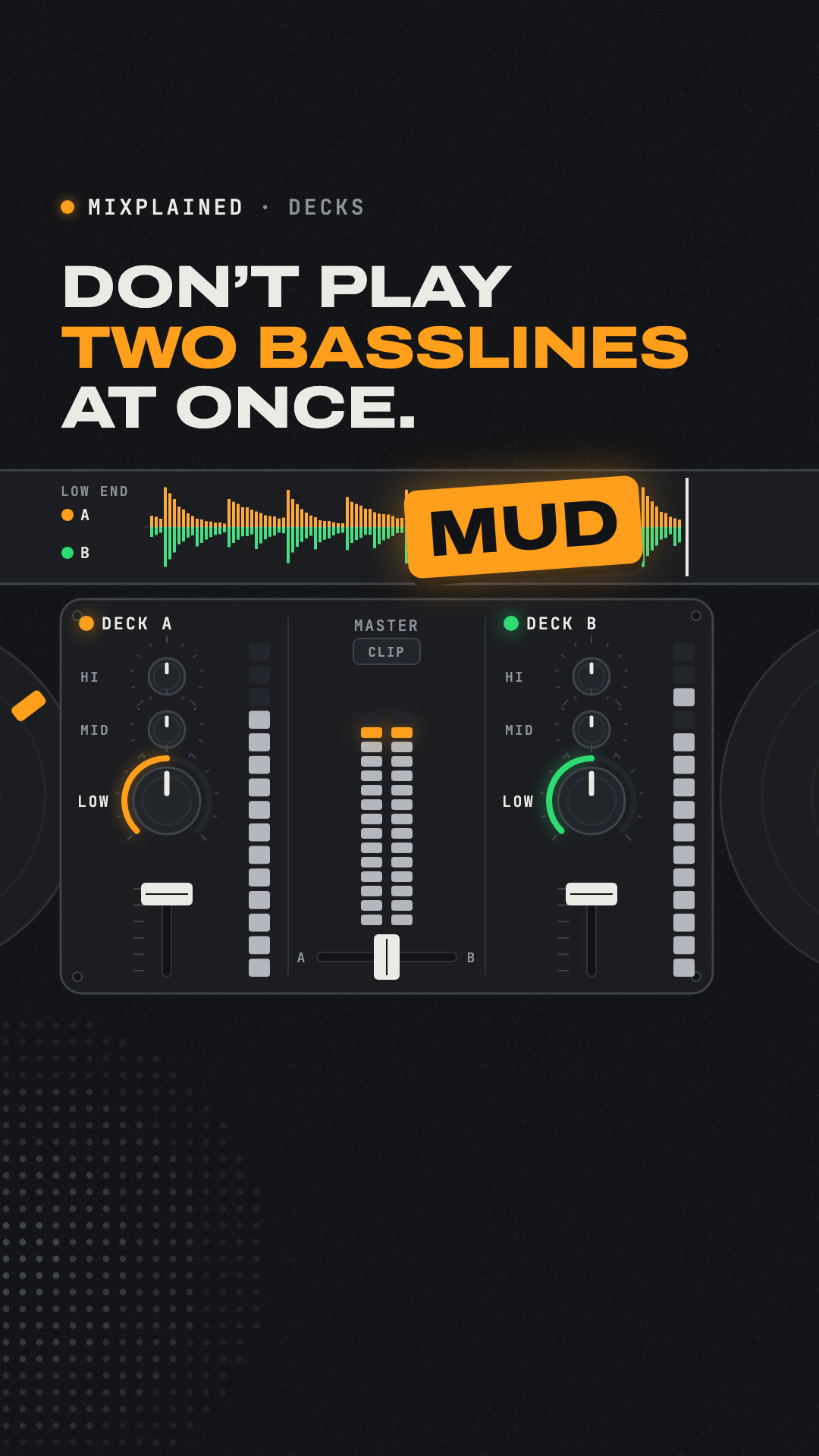
The bass swap: two basslines at once turn the low end to mud and push the level up, so DJs bring the next track in with its low EQ cut and trade the low knobs in one move on beat one of a phrase.
One bassline at a time. Swap it on the one.
Facts
- Two basslines at once will likely sound muddy and muffled on a club system – even when both tracks are in the same key. The DJ's fix is the bass swap.
- Kicks and basslines share the lowest frequencies – most of a kick's energy sits around 50–100 Hz – so they mask each other. On a DJ mixer the low EQ controls both.
- Low end also stacks: two identical signals added in step make a signal 6 dB larger. Lined up badly, layered lows can cancel instead and “suck the power out”.
- On Pioneer DJ's DJM-900NXS2 and DJM-A9 each EQ knob runs from +6 dB to −26 dB; some mixers cut fully – the DJM-V10's low band goes to −∞.
- The bass swap: bring the new track in with its low EQ cut, then turn its low up as you turn the old track's low down – at the moment the new bassline arrives.
- Tracks usually change at the top of a phrase – a new instrument, a fill or a crash, typically every 32 beats – so a swap on beat one of a phrase lands with the music.
Sources
- MusicRadar: 5 essential EQ & filter tricks for DJs (Harold Heath, 2024) · MusicRadar checked 7 October 2026
- Native Instruments Blog: 5 basic DJ transitions to keep your music in the flow (Sara Simms, 2024) · Native Instruments checked 7 October 2026
- Native Instruments Blog: Top 25 DJ tips to improve your skills (Sara Simms, 2024) · Native Instruments checked 7 October 2026
- Sound On Sound: Mix tips for kick & bass (Paul White, 2011) · Sound On Sound checked 7 October 2026
- Sound On Sound: Live side-chain compression (Len Sasso, 2010) · Sound On Sound checked 7 October 2026
- Sound On Sound: Q. What pan law setting should I use? (Hugh Robjohns, 2016) · Sound On Sound checked 7 October 2026
- Sound On Sound: Phase demystified (Mike Senior, 2008) · Sound On Sound checked 7 October 2026
- AlphaTheta: DJM-900NXS2 operating instructions (quick start guide, DRH1330C), pp. 13–14 · AlphaTheta checked 7 October 2026
- AlphaTheta: DJM-A9 instruction manual (DRI1785B), pp. 25–26 · AlphaTheta checked 7 October 2026
- AlphaTheta: DJM-V10 instruction manual (DRI1643C), p. 27 · AlphaTheta checked 7 October 2026
- DJ TechTools: How to DJ 101 – why you must understand phrasing (Ryan Dejaegher, 2014) · DJ TechTools checked 7 October 2026
- Garcia: On and on – repetition as process and pleasure in electronic dance music (Music Theory Online, 2005) · Society for Music Theory checked 7 October 2026
- Vande Veire: auto-dj, an automatic DJ system for drum and bass (master's thesis code, Ghent University, 2017) – songtransitions.py · GitHub (Vande Veire) checked 7 October 2026
Fully cut isn't always silent: on many club mixers the low EQ stops at −26 dB.
All sound is original: synthesised for the episode, no samples, no licensed tracks. The narrator’s voice is AI-generated. General information. Features differ by software, player and version – check your own manual. Read how facts are checked and corrected.
Script
Don't play two basslines at once. Even in the same key, the low end usually turns to mud. Kicks and basslines share the lowest frequencies and mask each other. And they stack: two identical waves, in step, come out 6 dB louder. So the new track comes in with its low knob down: −26 dB. But that knob holds the kick too, so the new track plays thin. Then, on beat one of a phrase, the low knobs trade places in one move. Tracks usually change there anyway, so the swap feels like part of the music. One bassline at a time. Swap it on the one.
Sources last checked 7 October 2026.