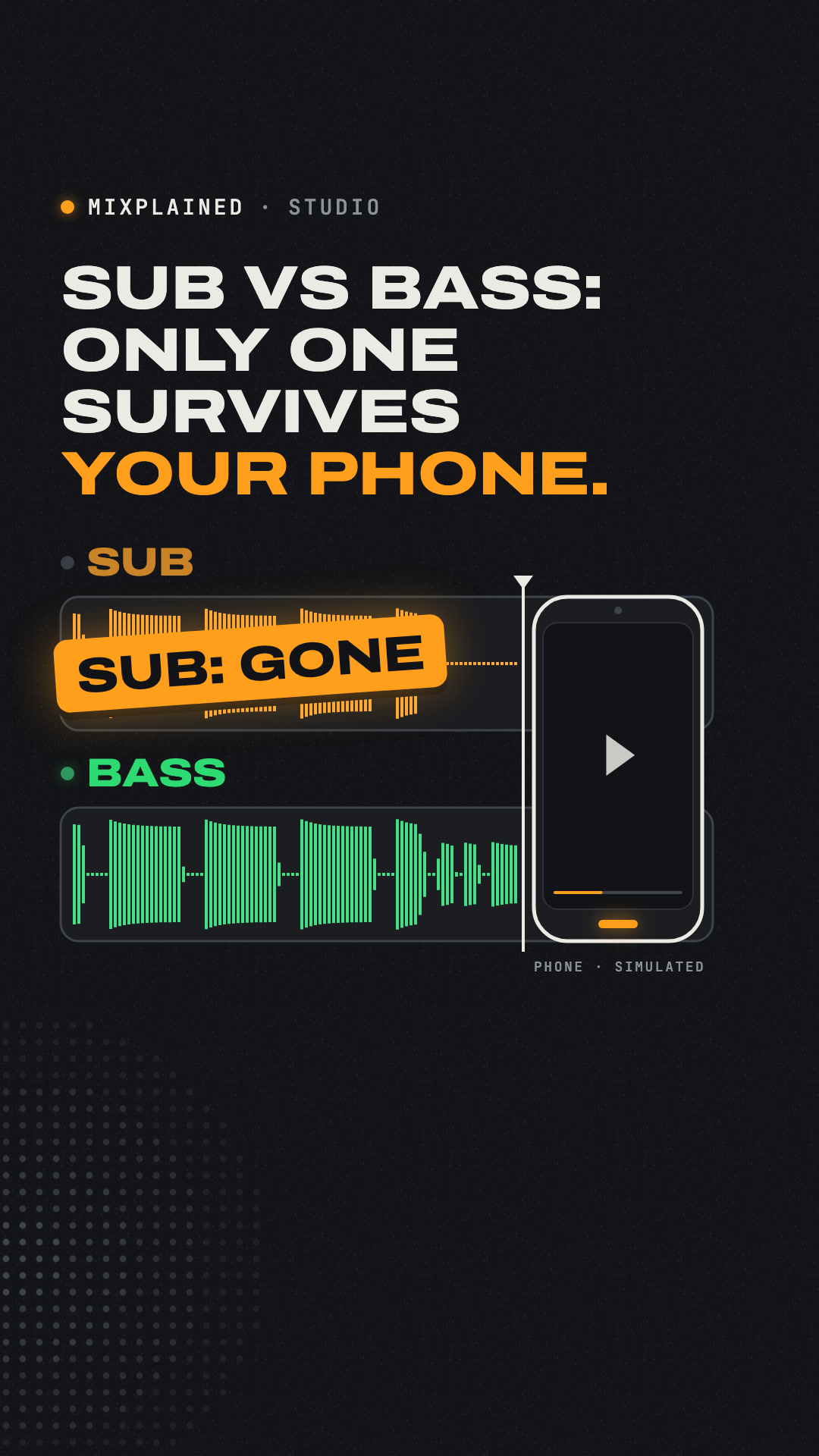
Sub-bass (about 20–60 Hz) vanishes on a phone speaker. Producers add harmonics so the bass line still comes through – and your brain fills in the missing note.
Sub for the club. Harmonics for the phone.
Facts
- Sub-bass is roughly 20–60 Hz and is usually felt more than heard; bass is roughly 60–250 Hz. Sources draw the line a little differently – some engineers start talking about sub-bass around 70 Hz.
- Small speakers have a poor bass response: below 100 Hz their output is usually negligible, and some reach no lower than several hundred hertz, so phone speakers strip away almost all the sub-bass. Waves gives about 200 Hz for laptop speakers; one 15 × 11 mm micro speaker is rated from 700 Hz.
- Turning the sub up barely helps: for the same output, a speaker cone has to move four times as far for every octave down, and EQ can only boost what is already in the sound – a pure sine has nothing higher up to boost.
- Producers add harmonics instead: saturation, distortion or a brighter layer on top of the sub, so the bass line reaches small speakers.
- The brain hears a tone's pitch even when its fundamental is removed – the “missing fundamental”, firmly established in the mid-20th century. Harmonics at 110, 165, 220 Hz… still point to a 55 Hz note.
- Bass enhancers automate the trick: Sound On Sound reviewed Waves MaxxBass as brand new in 1998, and Waves holds a 1999 US patent on creating a “psycho-acoustic” low-frequency sensation from harmonics.
Sources
- Teach Me Audio: Audio spectrum · Teach Me Audio checked 7 October 2026
- iZotope: How to EQ bass to sit well in the mix (Nick Messitte, 2025) · iZotope checked 7 October 2026
- Wikipedia: Sub-bass · Wikipedia checked 7 October 2026
- Larsen & Aarts: Reproducing low-pitched signals through small loudspeakers (J. Audio Eng. Soc. 50/3, 2002) · Audio Engineering Society checked 7 October 2026
- Waves: MaxxBass user manual · Waves checked 7 October 2026
- Same Sky (formerly CUI Devices): CMS-15113-037X miniature speaker datasheet · Same Sky checked 7 October 2026
- iZotope: Essential tips for listening to your mix on different playback systems (Nick Messitte, 2025) · iZotope checked 7 October 2026
- Attack Magazine: Ten tips for better basslines – 6. Sub-bass (Bruce Aisher, 2013) · Attack Magazine checked 7 October 2026
- Attack Magazine: Ten tips for better basslines – 5. EQ (Bruce Aisher, 2013) · Attack Magazine checked 7 October 2026
- Attack Magazine: Ten tips for better basslines – 7. Layering bass sounds (Bruce Aisher, 2013) · Attack Magazine checked 7 October 2026
- Sound On Sound: Mixing bass (Mike Senior, 2012) · Sound On Sound checked 7 October 2026
- Sound On Sound: Waves MaxxBass review (Paul White, February 1998) · Sound On Sound checked 7 October 2026
- Oxenham: Pitch perception (Journal of Neuroscience 32/39, 2012) · Journal of Neuroscience checked 7 October 2026
- iZotope: A guide to fundamental frequency and harmonics in music (Ian Stewart, 2024) · iZotope checked 7 October 2026
- Waves: MaxxBass bass enhancer plugin · Waves checked 7 October 2026
- US patent 5,930,373: Method and system for enhancing quality of sound signal (Shashoua & Glotter, K S Waves Ltd, 1999) · USPTO checked 7 October 2026
Overdo the harmonics and a mix can sound boxy on big speakers – check on both.
All sound is original: synthesised for the episode, no samples, no licensed tracks. The narrator’s voice is AI-generated. General information. Features differ by software, player and version – check your own manual. Read how facts are checked and corrected.
Script
Sub vs bass: only one survives your phone. Sub-bass: about 20 to 60 Hz, felt more than heard. Bass: about 60 to 250. A phone-sized speaker usually plays next to nothing below 100 Hz. Here's a drop with a pure sine sub. Now, through a phone. Turning it up barely helps: every octave down, the cone must move four times as far. So producers add harmonics: saturation, distortion, a brighter layer, or plugins like MaxxBass. Same notes, saturated. Phone again. That 55 Hz note still isn't there. Your brain rebuilds it: the missing fundamental. Sub for the club. Harmonics for the phone.
Sources last checked 7 October 2026.