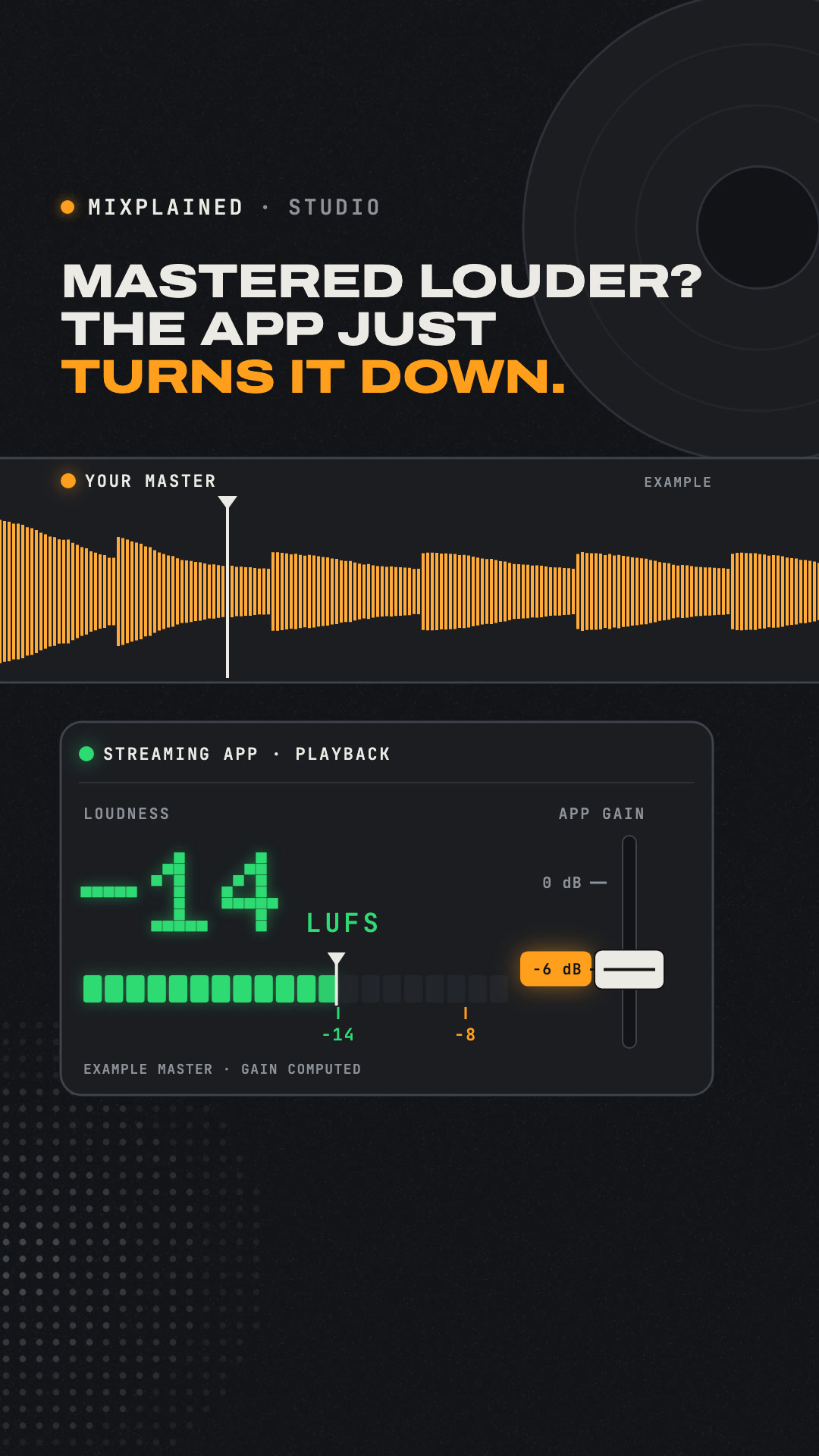
Loudness normalisation: Spotify plays tracks at −14 LUFS by default, so a master squashed to be loud gets turned down – and next to a dynamic master at the same loudness, its kicks sound smaller.
Loud gets turned down. Punch doesn't.
Facts
- Spotify normalises playback to −14 LUFS, measured to the ITU 1770 standard; Normal is the default level and Premium listeners can pick Loud (−11) or Quiet (−19). Louder masters get negative gain; quieter ones are lifted only as far as their headroom allows.
- Normalisation is only a volume change during playback: Spotify doesn't alter the file, and turning a loud master down adds “no additional distortion”. A master at −8 LUFS plays 6 dB quieter at −14 (example, computed) – and keeps its squashed shape.
- The loudness war: a limiter shaves the peaks so the whole track can be pushed up, louder but less dynamic. In 2008 fans complained that Metallica's Death Magnetic sounded better in Guitar Hero than on CD.
- At equal loudness the dynamic master keeps its taller peaks, so its kicks hit harder. Sound On Sound calls hyper-compressed music “dull and feeble” by comparison; Apple's mastering guide says loud masters “can make tracks actually sound weaker”.
- Apple's Sound Check plays songs at approximately the same loudness (Apple publishes no target figure). Spotify's web player and third-party devices such as TVs and speakers don't normalise, and listeners can switch it off.
- The idea came from broadcast: ITU-R BS.1770 defines the loudness measurement, and European broadcasters normalise programmes to −23 LUFS under EBU R 128 (first published in 2010).
Sources
- Spotify for Artists: Loudness normalization · Spotify checked 7 October 2026
- Spotify Support: Volume normalization · Spotify checked 7 October 2026
- Apple Digital Masters technology brief (April 2021) · Apple checked 7 October 2026
- Sound On Sound: The end of the loudness war? (Hugh Robjohns, 2014) · Sound On Sound checked 7 October 2026
- Rolling Stone: Fans complain after “Death Magnetic” sounds better on “Guitar Hero” than CD (2008) · Rolling Stone checked 7 October 2026
- MusicRadar: Death Magnetic sounds better in Guitar Hero (2008) · MusicRadar checked 7 October 2026
- EBU R 128-2023: Loudness normalisation and permitted maximum level of audio signals · EBU checked 7 October 2026
- ITU-R BS.1770: Algorithms to measure audio programme loudness and true-peak audio level · ITU checked 7 October 2026
Example levels. Spotify's web player and third-party devices (TVs, speakers) don't normalise.
All sound is original: synthesised for the episode, no samples, no licensed tracks. The narrator’s voice is AI-generated. General information. Features differ by software, player and version – check your own manual. Read how facts are checked and corrected.
Script
Mastered louder? The app just turns it down. To win the loudness war, masters got squashed: peaks shaved off, the whole track pushed up. In 2008, fans said Metallica's Death Magnetic sounded better in Guitar Hero than on CD. Today, apps measure loudness, like TV does, and play every track about equally loud. Spotify's default is −14 LUFS. A master at −8 gets turned down 6 dB. Same loudness now. But listen to the kicks. The squashed one lost its peaks, so its kicks sound smaller. Even Apple's mastering guide warns: loud masters can sound weaker. Loud gets turned down. Punch doesn't.
Sources last checked 7 October 2026.