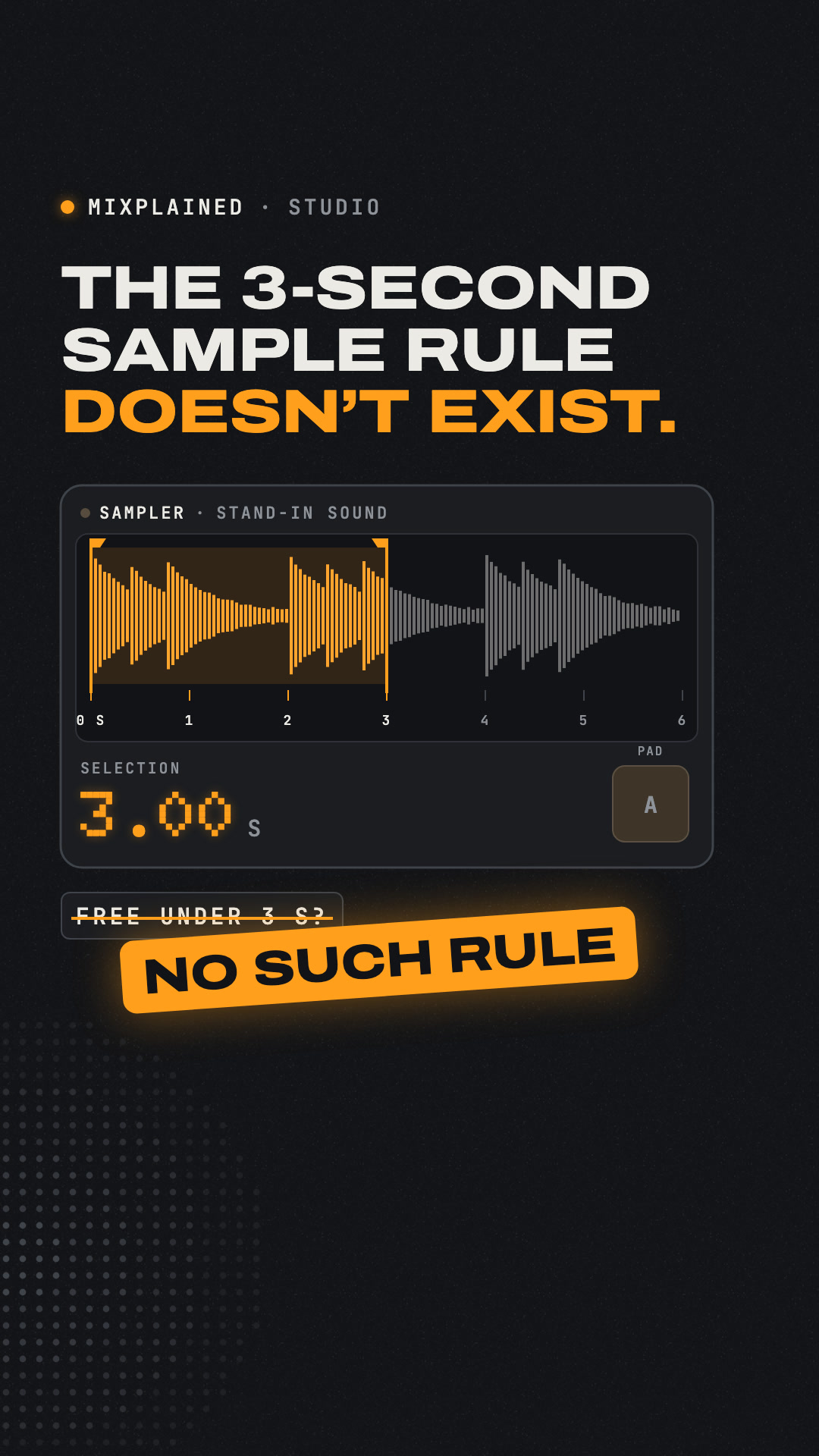
No number of seconds makes a sample free. One US appeals court said two seconds still needed a licence, another let 0.23 seconds pass, and the EU asks whether the ear can still recognise it.
Seconds don't clear a sample. Permission does.
Facts
- A record usually holds two copyrights: the song (the musical composition) and the sound recording. The US Copyright Office calls them “two separate works”, and clearing a sample usually means asking the label for the recording and the publisher for the song.
- No length makes a sample free. The US Copyright Office: “There are no legal rules permitting the use of a specific number of words, a certain number of musical notes, or percentage of a work.” Sound On Sound: samples aren't free “when under three seconds long”.
- Bridgeport Music v. Dimension Films (US 6th Circuit, 2005): a two-second sample of a three-note guitar riff was copied, pitched down and looped to 16 beats. For sound recordings the court allowed no “too small to matter” defence: “Get a license or do not sample.” It left fair use open.
- VMG Salsoul v. Ciccone (US 9th Circuit, 2016): a 0.23-second horn hit, allegedly sampled for Madonna's Vogue, was too trivial to infringe because a general audience would not recognise it. The court knowingly created a circuit split; in 2025 the 7th Circuit still set the two rules side by side without choosing.
- Pelham (EU Court of Justice, C-476/17, 29 July 2019): Kraftwerk's two-second rhythm from “Metall auf Metall” (1977), looped in “Nur mir” (1997). Even a very short sample needs the record producer's permission unless it is used “in a modified form unrecognisable to the ear”. Kraftwerk sued in 1999.
- On 14 April 2026 the same court (C-590/23) ruled that a recognisable sample can count as “pastiche” – an exception German law has had since 7 June 2021 – if it engages with the original in a recognisable artistic dialogue. The Kraftwerk case went back to Germany's Federal Court of Justice.
Sources
- US Copyright Office: FAQ – Can I use someone else's work? · US Copyright Office checked 7 October 2026
- US Copyright Office: Circular 56A – Copyright registration of musical compositions and sound recordings · US Copyright Office checked 7 October 2026
- Sound On Sound: Sample clearance – the SOS guide to copyright law on sampling (Richard Salmon, March 2008) · Sound On Sound checked 7 October 2026
- Bridgeport Music, Inc. v. Dimension Films, 410 F.3d 792 (6th Cir. 2005), amended opinion, 3 June 2005 · 6th Circuit checked 7 October 2026
- Bridgeport Music, Inc. v. Dimension Films, slip opinion 04a0297p.06 (6th Cir., 7 Sept 2004) · 6th Circuit checked 7 October 2026
- VMG Salsoul, LLC v. Ciccone, 824 F.3d 871 (9th Cir. 2016) · 9th Circuit checked 7 October 2026
- Richardson v. Kharbouch, Nos. 24-1119 & 24-2378 (7th Cir., 16 Oct 2025) · 7th Circuit checked 7 October 2026
- 28 U.S. Code § 41 – Number and composition of circuits · Cornell LII checked 7 October 2026
- Court of Justice of the EU (Grand Chamber): Pelham and Others, C-476/17, judgment of 29 July 2019 (ECLI:EU:C:2019:624) · CJEU checked 7 October 2026
- Court of Justice of the EU (Grand Chamber): Pelham (concept of ‘pastiche’), C-590/23, judgment of 14 April 2026 (ECLI:EU:C:2026:290) · CJEU checked 7 October 2026
- BBC News: Kraftwerk win 20-year sampling case over Metal On Metal (30 July 2019) · BBC checked 7 October 2026
Not legal advice: sampling law differs by country and by court. Clear samples with the rights holders.
All sound is original: synthesised for the episode, no samples, no licensed tracks. The narrator’s voice is AI-generated. General information. Features differ by software, player and version – check your own manual. Read how facts are checked and corrected.
Script
The 3-second sample rule doesn't exist. One sample can need two permissions: the recording, and the song. In 2005, a US appeals court weighed two seconds of guitar: three notes, pitched down, looped. Its rule for recordings: “Get a license or do not sample.” In 2016, another appeals court let a 0.23-second horn hit in Madonna's Vogue pass. Listeners wouldn't recognise the source. Same country, opposite answers. In Europe, Kraftwerk's two-second rhythm reached the EU's top court. The 2019 ruling: even a very short sample needs permission, unless it's unrecognisable to the ear. Seconds don't clear a sample. Permission does.
Sources last checked 7 October 2026.