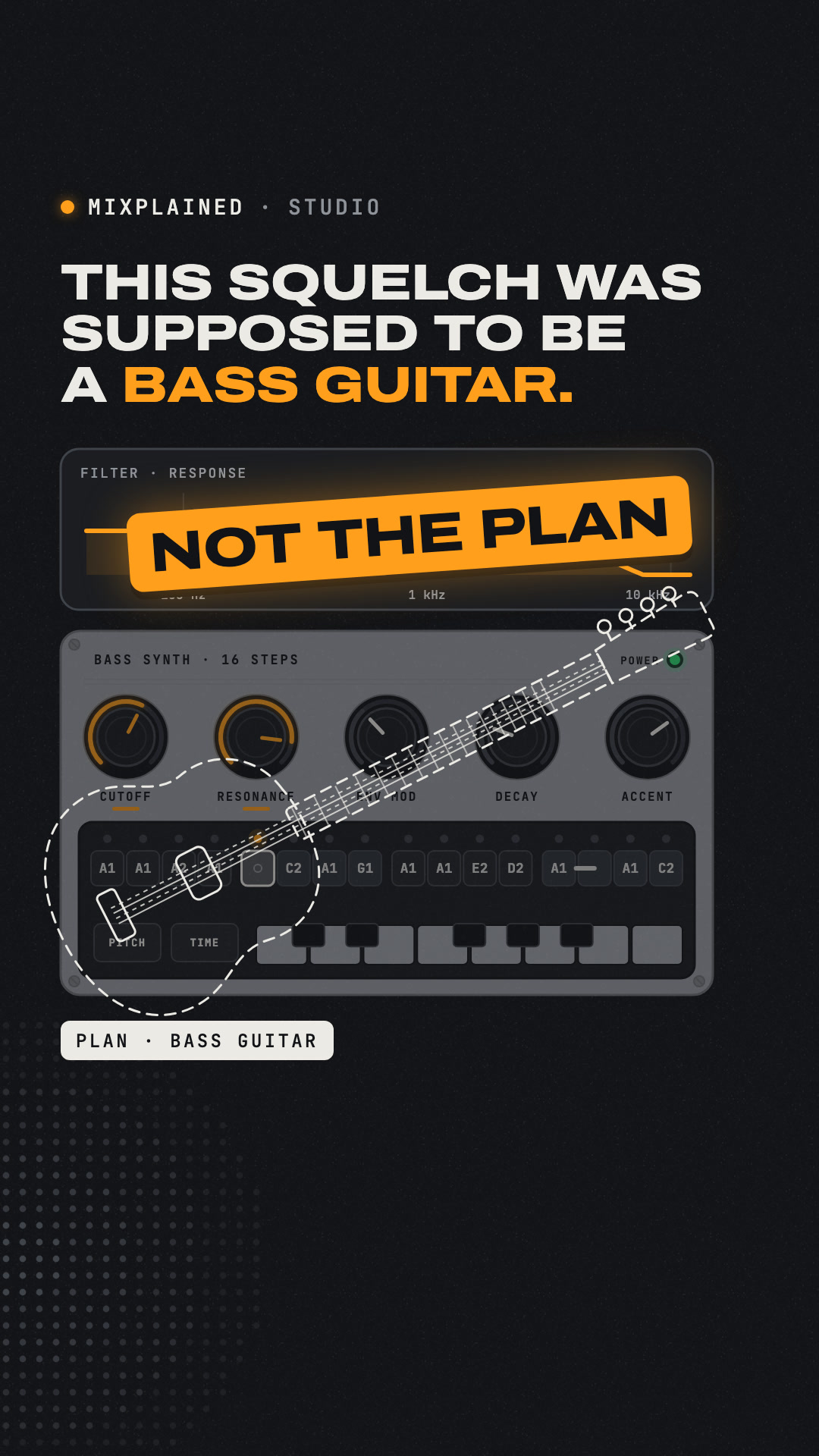
Roland's TB-303 (1981) was built to stand in for a bass player and flopped. In Chicago, Phuture couldn't program a cheap one, so DJ Pierre twisted its cutoff and resonance as it played: the squelch of “Acid Tracks” and acid house.
Built to fake a bass. Twisted into acid.
Facts
- Roland launched the TB-303 Bass Line at the end of 1981 (US price $395). Roland says the plan was to recreate an electric bass guitar for solo performers, synced to its TR-606 drum machine as a portable “backing band”.
- It didn't really sound like a bass guitar, and it was hard to program: you entered every pitch first, then the timing, then accents and slides. It flopped. Roland says about 10,000 were made (Sound On Sound once reported a rumour of nearly 20,000).
- Second-hand 303s went cheap. DJ Pierre remembers Spanky paying about $40 for Phuture's (Spanky has recalled $200), and it came with Japanese instructions. Around 1985 in Chicago, still working out how to program it, Pierre twisted its cutoff and resonance while a pattern played. That jam became “Acid Tracks”.
- Ron Hardy's first play of the tape at the Music Box emptied the dancefloor; after three more plays that night the crowd was won over. Marshall Jefferson had Phuture slow it from about 128 to 120 BPM, and Trax released it in 1987. In 1988 acid house exploded in Britain.
- On a 303, an accent raises the filter cutoff as well as the volume (quick repeated accents push it higher still), and a slide ties one note into the next. Roland's TB-03 (2017) keeps the original Pitch and Time write modes.
- The flop is now a collector's item: by 2017 an original fetched over £2,000 second-hand (MusicRadar).
Sources
- Roland: 303 Day – the 303 story · Roland checked 8 October 2026
- Roland Articles: Lifetime Achievement – DJ Pierre and Phuture (2022) · Roland checked 8 October 2026
- Roland: TB-303 Software Bass Line · Roland checked 8 October 2026
- Roland Articles: Mastering the TB-303 sequencer in Roland Cloud (2025) · Roland checked 8 October 2026
- Roland U.S. Blog: TB-303 acid flashback – the fall and rise of the TB-303 (2013) · Roland checked 8 October 2026
- Roland: TB-03 Bass Line · Roland checked 8 October 2026
- The Guardian: Tadao Kikumoto invents the Roland TB-303 (2011) · The Guardian checked 8 October 2026
- Red Bull Music Academy Daily: The story of acid house, as told by DJ Pierre (2012) · Red Bull Music Academy checked 8 October 2026
- Electronics & Music Maker: Roland TB-303 Bass Line (Tony Bacon, April 1982) · Electronics & Music Maker checked 8 October 2026
- The Fader: Back to the Phuture – DJ Pierre on inventing acid (2014) · The Fader checked 8 October 2026
- Sound On Sound: The history of Roland, part 2 (Gordon Reid, 2004) · Sound On Sound checked 8 October 2026
- Attack Magazine: Roland TB-303 – not a real bass guitar (2020) · Attack Magazine checked 8 October 2026
- Attack Magazine: You just have to move your feet – 30 years of acid (2014) · Attack Magazine checked 8 October 2026
- The Guardian: A second summer of love (Luke Bainbridge, 2008) · The Guardian checked 8 October 2026
- The Guardian: Charanjit Singh on how he invented acid house … by mistake (2011) · The Guardian checked 8 October 2026
- Robin Whittle (Devil Fish designer): Some unique aspects of the TB-303's sound · Robin Whittle checked 8 October 2026
- Wikipedia: Acid Tracks · Wikipedia checked 8 October 2026
- Wikipedia: Roland TB-303 · Wikipedia checked 8 October 2026
- MusicRadar: Roland TB-03 Bass Line review (Bruce Aisher, 2017) · MusicRadar checked 8 October 2026
All sound is original: synthesised for the episode, no samples, no licensed tracks. The narrator’s voice is AI-generated. General information. Features differ by software, player and version – check your own manual. Read how facts are checked and corrected.
Script
This squelch was supposed to be a bass guitar. Roland's TB-303, 1981: a bass player in a box for solo musicians. It didn't sound like one. It flopped: about 10,000 made. Programming it was a puzzle: pitches first, then timing. Around 1985, Chicago's Phuture got one cheap and couldn't crack it. So DJ Pierre twisted the cutoff and resonance while it played. Same notes. Only the knobs moved. Accents kick the filter open. Slides glue notes together. Out in 1987 as “Acid Tracks”. A year later, acid house swept Britain. Built to fake a bass. Twisted into acid.
Sources last checked 8 October 2026.