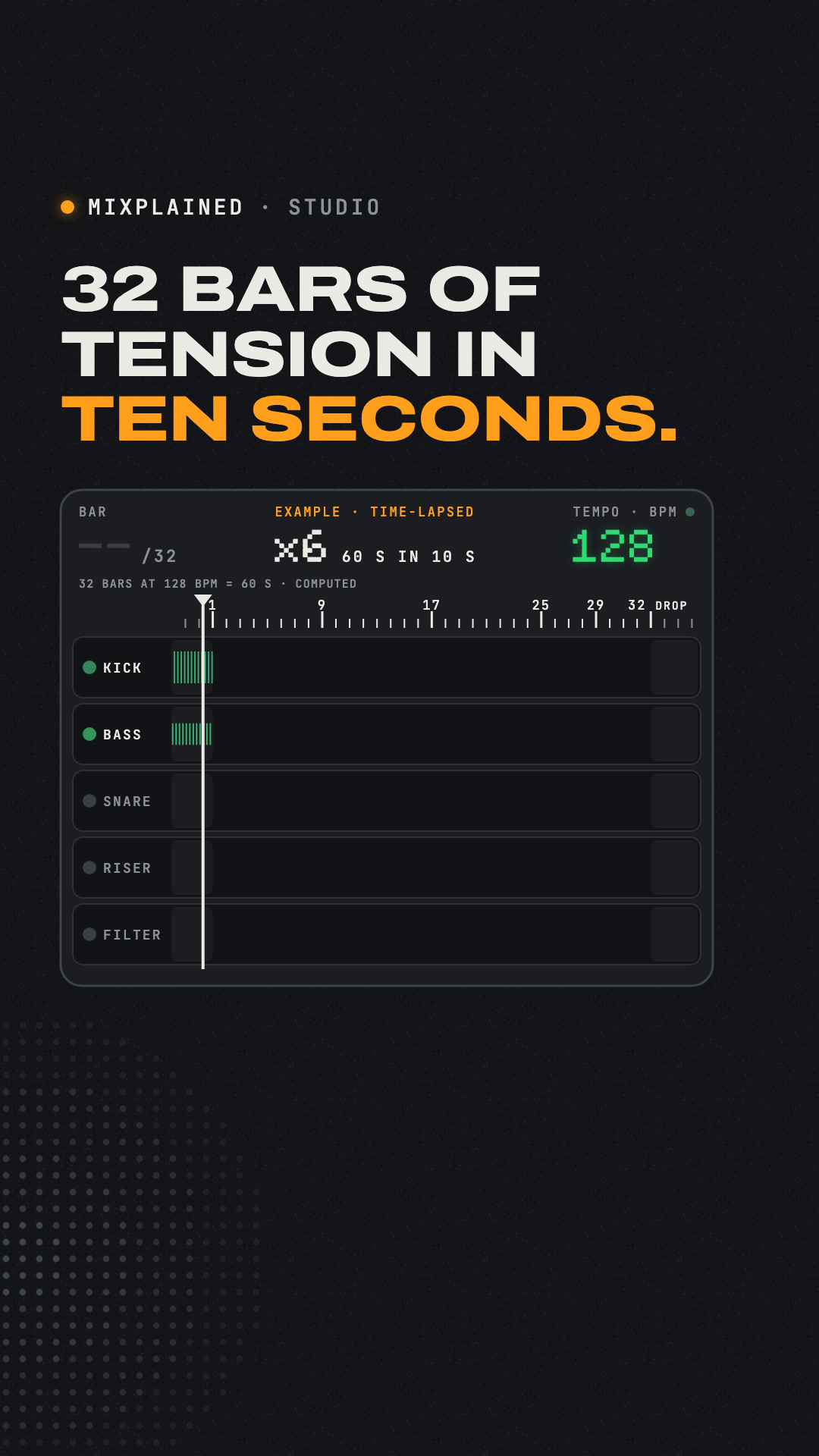
A build-up and drop, time-lapsed: the kick and bass cut out, a snare roll doubles from quarters to thirty-seconds at the same tempo, a riser climbs, a filter thins the low end, a beat of near-silence – then the kick and bass come back.
Take the bass away. Then give it back.
Facts
- Build-ups stack tension in layers: the kick and bass usually drop out, a snare roll divides from quarter notes towards a roll, risers climb in pitch and filters thin the sound. Solberg (Dancecult, 2014) names uplifters, the “drum roll effect”, large frequency changes and the removal and return of bass and bass drum.
- The snare roll never changes the tempo: dividing the note value gives “the illusion and the effect of a tempo increase” (Solberg 2014). Rolls often step from quarters to eighths to sixteenths, and trance rolls can end in thirty-second notes (Attack Magazine 2020; Iler 2011).
- Many builds end with a short break just before the drop – a beat or more of near-silence, or a lone fill. Music theorists call it a “rest measure” (Iler 2011) or a “pre-drop break” (Grosz et al. 2025) and describe it as holding the tension, not losing it.
- The drop is named after its most audible feature: “the reintroduction of the bass and bass drum” (Solberg 2014).
- In a motion-capture study, 16 dancers moved most at the drop (Solberg & Jensenius, 2016). In another, 24 listeners' skin conductance was significantly higher in drop sections than in the rest of the break routine (Solberg & Dibben, 2019).
- Dance tracks usually add or remove layers after 2, 4, 8, 16 or 32 bars. At 128 BPM – the most used EDM tempo, per Moelants (2008) – 32 bars last 60 seconds (computed); this video time-lapses them into about ten.
Sources
- Solberg: “Waiting for the bass to drop” – correlations between intense emotional experiences and production techniques in build-up and drop sections of electronic dance music (Dancecult 6/1, 2014) · Dancecult checked 7 October 2026
- Solberg & Jensenius: Pleasurable and intersubjectively embodied experiences of electronic dance music (Empirical Musicology Review 11/3–4, 2016) · Empirical Musicology Review checked 7 October 2026
- Iler: Formal devices of trance and house music – breakdowns, buildups and anthems (MM thesis, University of North Texas, 2011) · University of North Texas checked 7 October 2026
- Attack Magazine: 10 snare rolls for the drop (Adam Douglas, 2020) · Attack Magazine checked 7 October 2026
- Grosz, Solberg, Katz, Vu, Jensenius & Patel-Grosz: An outline of the narrative grammar of electronic dance music (Musicae Scientiae 29/4, 2025) · Musicae Scientiae checked 7 October 2026
- Solberg & Jensenius: Group behaviour and interpersonal synchronization to electronic dance music (Musicae Scientiae 23/1, 2019) · Musicae Scientiae checked 7 October 2026
- Solberg & Dibben: Peak experiences with electronic dance music – subjective experiences, physiological responses, and musical characteristics of the break routine (Music Perception 36/4, 2019; abstract) · Music Perception checked 7 October 2026
- Osborn: Risers, drops and a fourteen-foot cube – a transmedia analysis of Emil Nava, Calvin Harris and Rihanna's ‘This Is What You Came For’ (in Transmedia Directors, 2019) · Bloomsbury checked 7 October 2026
- Attack Magazine: What is the recipe for an effective breakdown? (Aykan Esen, 2023) · Attack Magazine checked 7 October 2026
- Computer Music: 6 essential build-up edit and fill tricks (2017) · MusicRadar / Computer Music checked 7 October 2026
- Future Music: 5 ways to make better build-ups and drops in your club tracks (2019) · MusicRadar / Future Music checked 7 October 2026
- MusicRadar: How to create an effective buildup and breakdown (Sara Simms, 2024) · MusicRadar checked 7 October 2026
All sound is original: synthesised for the episode, no samples, no licensed tracks. The narrator’s voice is AI-generated. General information. Features differ by software, player and version – check your own manual. Read how facts are checked and corrected.
Script
32 bars of tension in ten seconds. First, the kick and bass cut out. The snare counts quarters, eighths, sixteenths, thirty-seconds. A riser climbs, and a filter strips out the low end. Then, almost nothing. That's the drop. The big hit isn't new – it's the kick and bass coming back. But the tempo never moved. The snare only sounds like it's speeding up. And that near-silence isn't dead air. It holds the tension a moment longer. In a motion-capture lab, 16 dancers moved most at the drop. Take the bass away. Then give it back.
Sources last checked 7 October 2026.