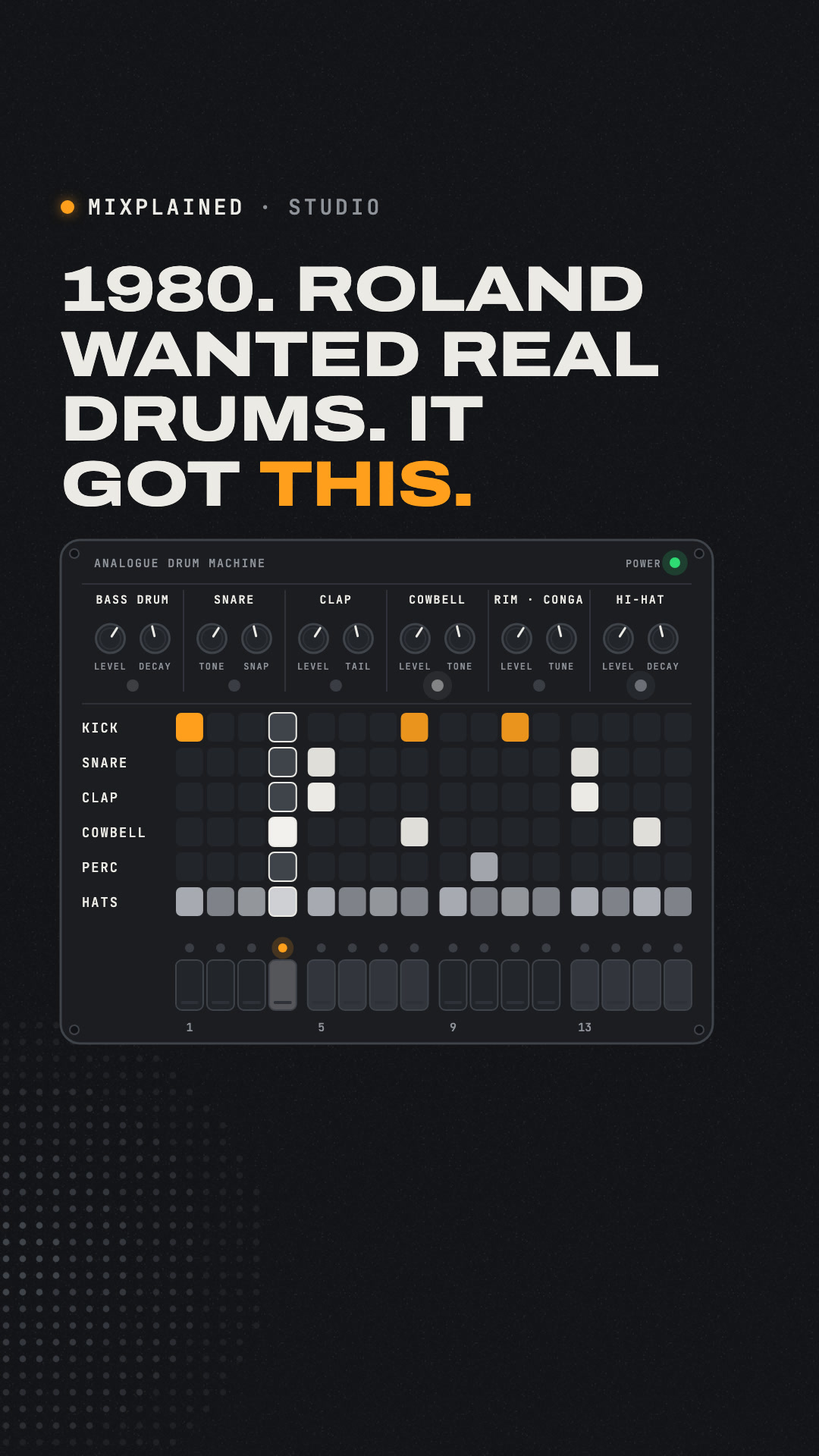
1980: Roland wanted realistic drums and built the TR-808. It sounded nothing like a kit and flopped – about 12,000 were made. Cheap second-hand, it fed hip-hop, electro, house and techno, and its long kick became the 808 bass.
The fake drum became the real bass.
Facts
- Roland's TR-808 Rhythm Composer came out in 1980 at a US list price of $1,195. Roland wanted realistic drums, but memory for recorded drum sounds was too expensive, so the 808 made its sounds with analogue circuits – and they sounded nothing like a real kit.
- Many producers wanted realistic drums (rivals such as the Linn LM-1 played recordings of real ones), and the 808 flopped. Early fans still used it: “Planet Rock” and Marvin Gaye's “Sexual Healing”, both 1982.
- Roland says part of its sizzle came from transistors rejected as “out of specification” (not faulty); when the supply ran out, the 808 was discontinued. It was out of production by 1983, after about 12,000 were made.
- By then, used 808s went for under $100, and hip-hop, electro, house and techno producers picked them up.
- The kick's decay knob stretches a short thump into a long, low boom. Pitched into notes – on samplers, later on synths – that boom became the “808” bassline.
- In trap the 808 bass is central, and “808” often names that bass even when it comes from a sample or a synth rather than the machine.
Sources
- Roland: The TR-808 story (808 Day page) · Roland checked 7 October 2026
- Roland: TR-808 Software Rhythm Composer · Roland checked 7 October 2026
- Roland Articles: Tadao Kikumoto – an exclusive conversation (2020) · Roland checked 7 October 2026
- Roland Articles: How Yellow Magic Orchestra launched the 808 revolution (2020) · Roland checked 7 October 2026
- Roland Articles: Nothing sounds quite like an 808 – analyzing the sound that changed music (2024) · Roland checked 7 October 2026
- The New Yorker: The 808 heard round the world (2015) · The New Yorker checked 7 October 2026
- The Guardian: The Roland TR-808 – the drum machine that revolutionised music (2014) · The Guardian checked 7 October 2026
- Sound On Sound: The history of Roland, part 2 (2014) · Sound On Sound checked 7 October 2026
- Sound On Sound: Synth Secrets – practical bass drum synthesis (2002) · Sound On Sound checked 7 October 2026
- Fact: Everything you ever wanted to know about the Roland TR-808 (2014) · Fact checked 7 October 2026
- Slate: 808 – The Movie is a must-watch doc for music nerds (2016) · Slate checked 7 October 2026
- Rolling Stone: 8 ways the 808 drum machine changed pop music (2016) · Rolling Stone checked 7 October 2026
- CBC News: Slaves to the rhythm – a history of the Roland TR-808 (2008) · CBC checked 7 October 2026
- BBC News: Roland TR-808 – the drum machine that refused to die (2014) · BBC checked 7 October 2026
- Native Instruments: How to make a trap beat (2022) · Native Instruments checked 7 October 2026
- Wikipedia: Roland TR-808 · Wikipedia checked 7 October 2026
All sound is original: synthesised for the episode, no samples, no licensed tracks. The narrator’s voice is AI-generated. General information. Features differ by software, player and version – check your own manual. Read how facts are checked and corrected.
Script
1980. Roland wanted real drums. It got this. It sounded nothing like a kit. Many producers wanted realism. It flopped. Still, 1982 brought “Planet Rock” and Marvin Gaye's “Sexual Healing”. But its sizzle came from off-spec transistors. They ran out after about 12,000 machines. New: $1,195. Used, by then: under $100. Hip-hop, electro, house and techno grabbed them. Now stretch the kick's decay. The thump becomes a boom. Pitch that boom into notes, and the drum becomes a bassline. In trap, an “808” now means that bass, often made without one. The fake drum became the real bass.
Sources last checked 7 October 2026.