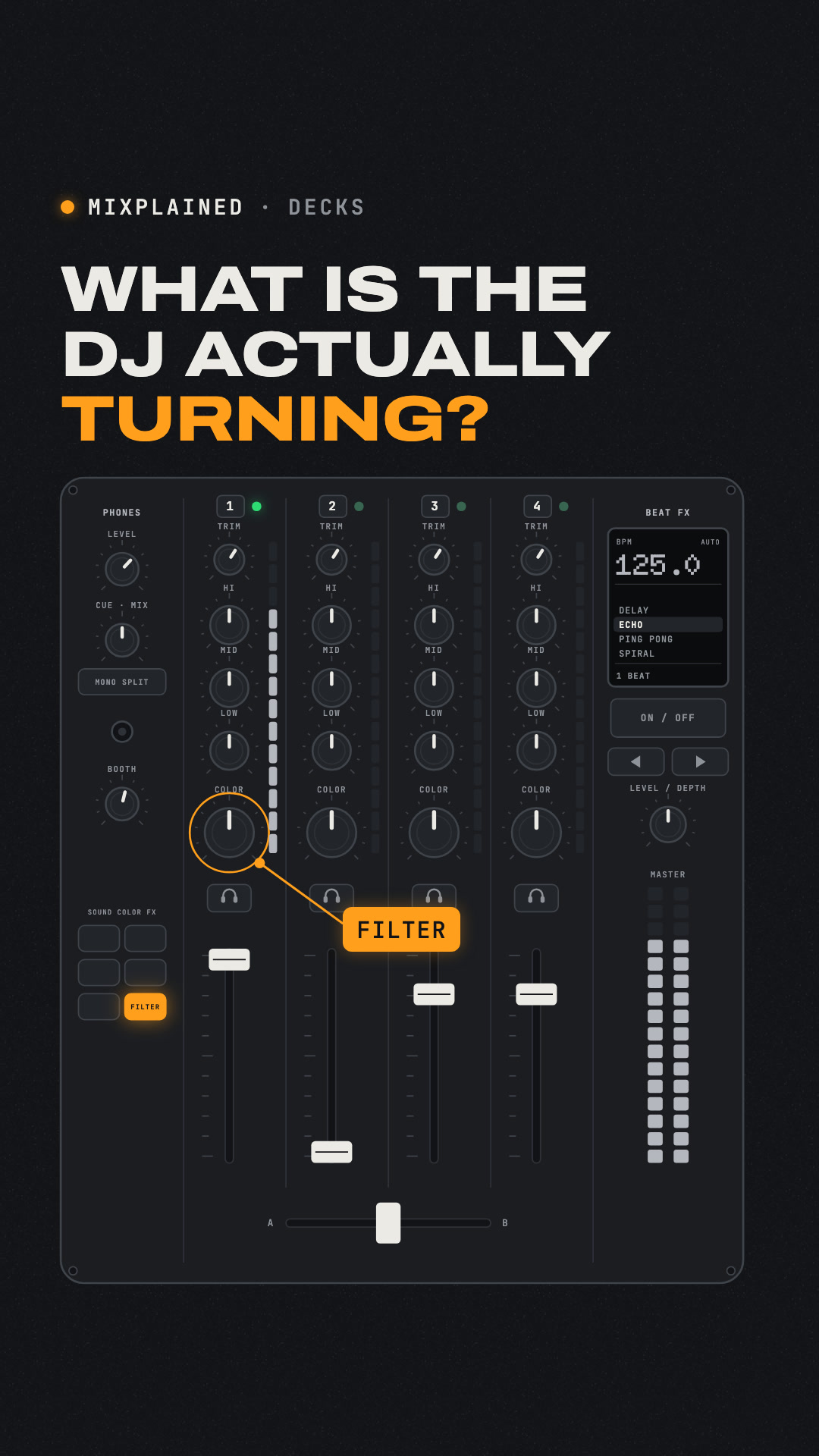
What the DJ is turning on a club mixer: the filter (muffled left, thin right), EQ knobs that boost 6 dB but cut 26, a bass cut that makes a breakdown live, 14 beat-synced effects, the headphone cue and the echo out.
Most mixer knobs take sound away – that's how a DJ builds a breakdown live.
Facts
- On club mixers like Pioneer DJ's DJM-A9, one knob per channel can be a two-way filter: turn it left for a low-pass filter that muffles the track (“as though you were listening to it from next door”, MusicRadar), right for a high-pass filter that cuts the bass; the centre is off. DJs also open a low-pass slowly to build tension.
- The DJM-A9's HI, MID and LOW knobs each boost up to +6 dB and cut down to −26 dB; on the DJM-V10 the HI and LOW bands go to −∞ (silence). DJs generally cut rather than boost – Digital DJ Tips' rule is “take away, don't add”.
- Cutting the bass is a live trick: MusicRadar says a one- or two-bar cut gives the room “a nice little lift”, an eight-bar cut can create “a mini impromptu breakdown”, and dancers often put their hands in the air. Bringing it back is what writers on DJing call dropping the bass or the beat (Solberg 2014; Butler 2006).
- The DJM-A9 has 14 Beat FX (among them Delay, Echo, Reverb and Roll) that follow the tempo, which it measures by itself between 70 and 180 BPM, plus six Sound Color FX. With Echo on, pulling the channel fader to zero leaves only the echo – the “echo out”. Echo's DJ roots go back to 1970s Jamaican dub, whose producers used tape echo machines such as the Roland Space Echo.
- A channel's Cue button sends it to the DJ's headphones only, so the next song can be lined up before the crowd hears it; with Mono Split it plays in one ear and the main mix in the other. One of the first DJ mixers, sound engineer Alex Rosner's red “Rosie”, was “two headphone amplifiers for the cueing system and a sliding fader”.
- Trim (gain) at the top of each channel sets how loud a song enters the mixer – Digital DJ Tips says “loads of DJs never touch them”. Channel faders and the crossfader then set each song's level in the mix; on the DJM-A9 a channel can bypass the crossfader (THRU).
Sources
- AlphaTheta (Pioneer DJ): DJM-A9 Instruction Manual (DRI1785-B, 2022) · AlphaTheta checked 9 October 2026
- Pioneer DJ: DJM-A9 product page · Pioneer DJ checked 9 October 2026
- AlphaTheta (Pioneer DJ): DJM-V10 Instruction Manual (DRI1643-C, 2020) · AlphaTheta checked 9 October 2026
- MusicRadar: 5 essential EQ & filter tricks for DJs (Harold Heath, 2024) · MusicRadar checked 9 October 2026
- Digital DJ Tips: 3 essential effects every DJ needs to know (Marc Santaromana, 2019) · Digital DJ Tips checked 9 October 2026
- Native Instruments Blog: DJ transitions (2024) · Native Instruments checked 9 October 2026
- Native Instruments Blog: DJ tips (2024) · Native Instruments checked 9 October 2026
- Digital DJ Tips: Cut, don't boost – the EQ rule every beginner DJ needs (Phil Morse, 2026) · Digital DJ Tips checked 9 October 2026
- Solberg: “Waiting for the bass to drop” – correlations between intense emotional experiences and production techniques in build-up and drop sections of electronic dance music (Dancecult 6/1, 2014) · Dancecult checked 9 October 2026
- Grosz, Solberg, Katz, Vu, Jensenius & Patel-Grosz: An outline of the narrative grammar of electronic dance music (Musicae Scientiae 29/4, 2025) · Musicae Scientiae checked 9 October 2026
- Digital DJ Tips: How to use the echo effect when DJing (Phil Morse, 2023) · Digital DJ Tips checked 9 October 2026
- Digital DJ Tips: Stop using echo out – do this instead (Phil Morse, 2026) · Digital DJ Tips checked 9 October 2026
- Wikipedia: DJ mixer · Wikipedia checked 9 October 2026
- Cross: A history of the development of DJ mixer features – an S&TS perspective (BA honors thesis, Cornell University, 2003) · Cornell University checked 9 October 2026
- Red Bull Music Academy: Alex Rosner lecture – Systematic sound (2003) · Red Bull Music Academy checked 9 October 2026
- Digital DJ Tips: DJ mixer gain controls – what they do and how to use them (Phil Morse, 2026) · Digital DJ Tips checked 9 October 2026
- Wikipedia: Dub music · Wikipedia checked 9 October 2026
All sound is original: synthesised for the episode, no samples, no licensed tracks. The narrator’s voice is AI-generated. General information. Features differ by software, player and version – check your own manual. Read how facts are checked and corrected.
Script
What is the DJ actually turning? Probably the filter. Left, and the song sounds like it's next door. Right, and the bass drains away. Or the EQ: highs, mids, lows. Each adds 6 decibels at most, but cuts 26. Kill the lows: the kick and bass almost vanish. Often, hands go up. Hold it for eight bars: a breakdown the track never had. And the drop? That's the DJ's too. That screen: 14 effects, timed to the beat. Like this echo. And the headphones? The DJ's already hearing the next song. You can't. Echo on, fader down. Only the echo is left.
Sources last checked 9 October 2026.