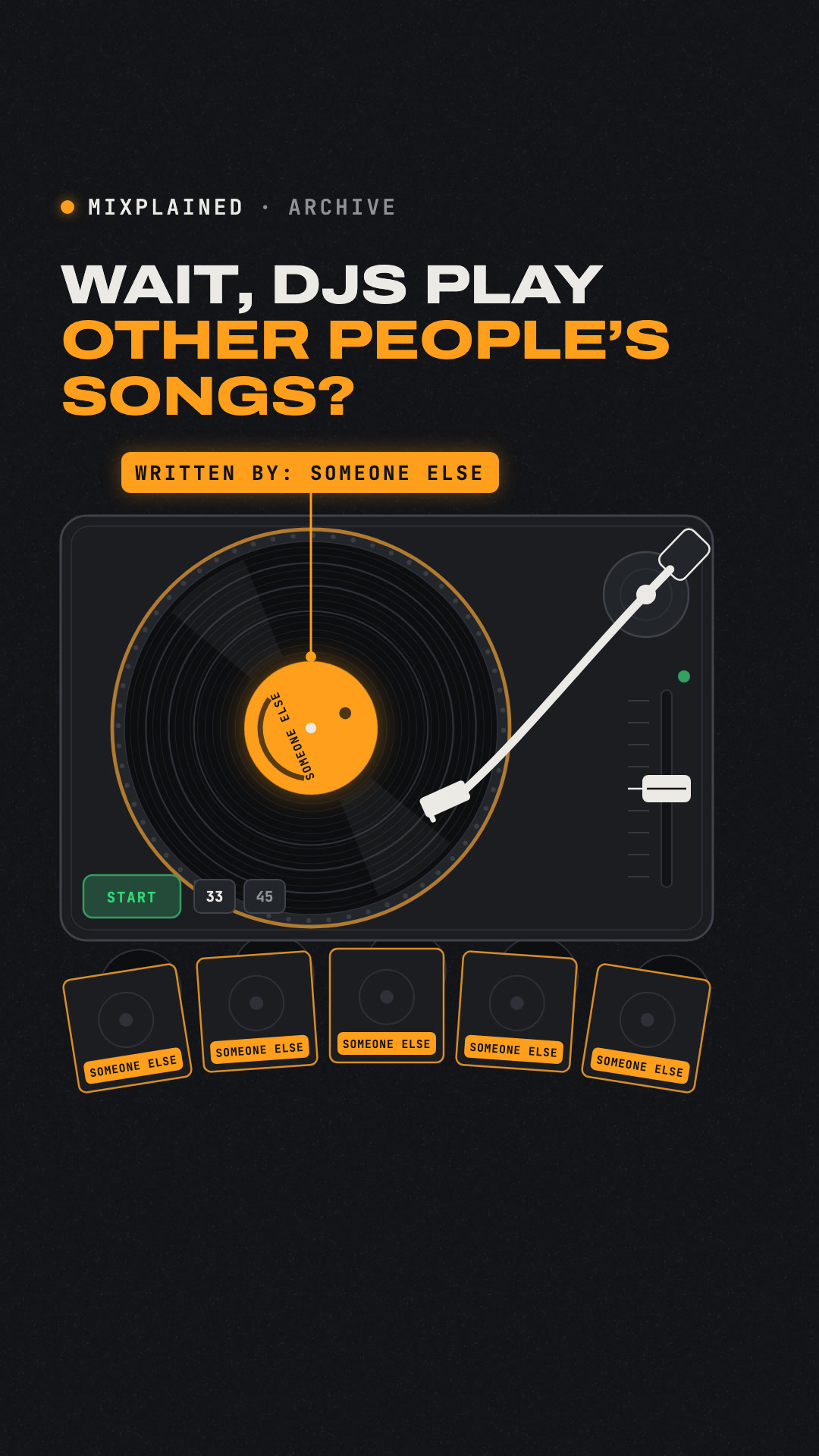
Yes – that was the job from the start: “disc jockey” is usually credited to Walter Winchell in 1935, for radio host Martin Block. Records once said “Not licensed for radio broadcast”; today fingerprint boxes help pay the songwriters.
Playing other people's records was the job from the start – now it pays their writers.
Facts
- “Disc jockey” is usually credited to columnist Walter Winchell, who reportedly coined it in 1935 for New York radio host Martin Block; the phrase was in print in Variety by 1941. Block's Make Believe Ballroom on WNEW (from February 1935) played records as if the nation's top dance bands were performing live – an idea and name he borrowed from Al Jarvis in Los Angeles. WNEW later built him a mock ballroom studio, chandelier included.
- Performers fought radio play: from 1932 to 1937, records of Paul Whiteman's orchestra carried the legend “Not Licensed for Radio Broadcast”. Whiteman went to court against WNEW's operator and won in 1939, but on 25 July 1940 a US appeals court (Judge Learned Hand) reversed it: the rights “ended with the sale of the records”. In Pennsylvania, bandleader Fred Waring had won the opposite ruling in 1937.
- Radio was already paying the songwriters: in the 1940 appeal, broadcasters argued that they paid millions of dollars a year to the copyright owners of the music they played.
- Club DJs turned playing records into a performance. In late-1960s New York, Francis Grasso – often credited as one of the first to beat-mix – kept the beat going from record to record at clubs such as the Sanctuary; he recalled changing records about every 2 minutes 12 seconds.
- In a 2024 count by the AFEM-backed #RespectTheCreators campaign, the music in DJ clips on Instagram was on average 97 % another artist's work, and 90 % of the clips didn't credit it. Many DJs are producers too.
- In the UK, PRS pays royalties when DJs play music at licensed venues and festivals, using setlists and, since October 2018, fingerprinting boxes from DJ Monitor – 78 boxes in 51 venues in 2026. A few seconds of audio can be enough to identify a track. In the Netherlands, DJ Monitor fingerprints about 70 % of festivals (Billboard, 2023).
Sources
- #RespectTheCreators: the campaign to accurately credit music in viral DJ videos (M Magazine, Daniel Cave, 18 Sep 2024; archived copy) · PRS for Music checked 9 October 2026
- Musicians losing out on millions due to wrongly allocated UK royalties, new research finds (Ed Gillett, 18 Nov 2025) · The Guardian checked 9 October 2026
- Disc jockey · Wikipedia checked 9 October 2026
- History of radio disc jockeys · Wikipedia checked 9 October 2026
- Martin Block · Wikipedia checked 9 October 2026
- Martin Block (Radio Hall of Fame inductee, 1988) · Radio Hall of Fame checked 9 October 2026
- Make Believe Ballroom · Wikipedia checked 9 October 2026
- RCA Mfg. Co. v. Whiteman, 114 F.2d 86 (2d Cir., 25 July 1940) · US Court of Appeals checked 9 October 2026
- Broadcasting magazine, 1 Aug 1940: “Right to Broadcast Recordings Upheld” (PDF pp. 38, 60) · Broadcasting checked 9 October 2026
- Francis Grasso started the journey (interview by Frank Broughton, 4 Feb 1999) · DJhistory checked 9 October 2026
- Francis Grasso · Wikipedia checked 9 October 2026
- DJ royalties and MRT · PRS for Music checked 9 October 2026
- Songs in DJ sets are notoriously hard to track – how a Dutch rights organization is paying royalties (Katie Bain, 24 Feb 2023) · Billboard checked 9 October 2026
- The 1% Reality: What the Numbers Tell Us About DJ Economics (Rufy Ghazi, 9 Jun 2025) · Attack Magazine checked 9 October 2026
All sound is original: synthesised for the episode, no samples, no licensed tracks. The narrator’s voice is AI-generated. General information. Features differ by software, player and version – check your own manual. Read how facts are checked and corrected.
Script
Wait, DJs play other people's songs? Mostly: in DJ clips on Instagram, about 97% of the music is someone else's. From the start: in 1935, Walter Winchell reportedly coined “disc jockey” for radio host Martin Block. He played dance-band records and pretended the bands were live, in a “Make Believe Ballroom”. But bandleaders pushed back. Paul Whiteman's records said “Not licensed for radio broadcast”. He took Block's station to court. In 1940, he lost. Late-1960s New York: club DJs like Francis Grasso kept the beat going, picking each record for the room. Today, in 51 UK venues, a box logs the tracks so their songwriters get paid. Sometimes, that's the DJ.
Sources last checked 9 October 2026.