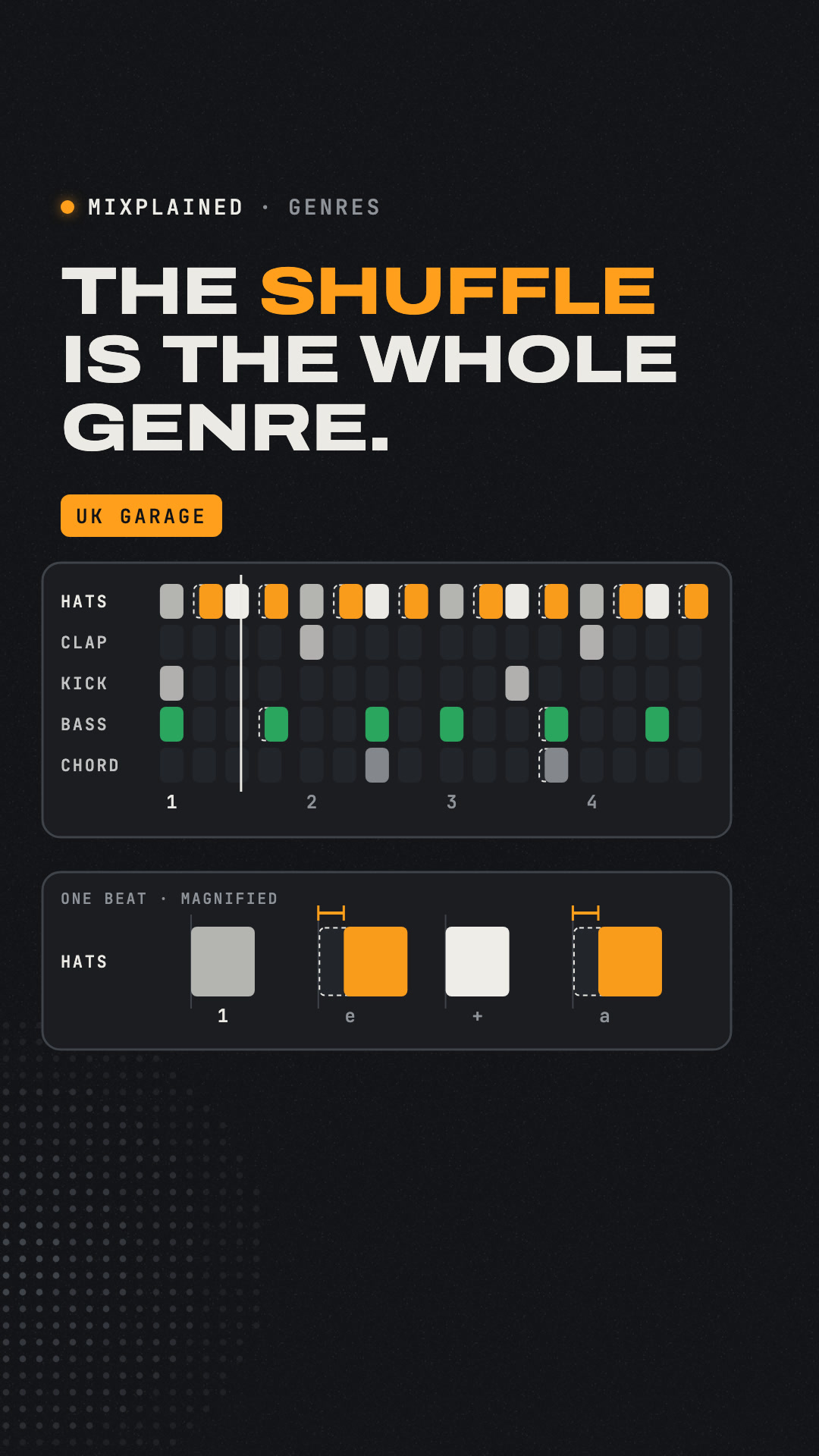
UK garage's shuffle: swing pushes every second sixteenth note late – at 132 BPM and 60 % swing, just 23 ms – and late-90s 2-step dropped the kicks on beats 2 and 4.
Swing the hats. Skip the kick.
Facts
- UK garage took shape in London in the mid-1990s from New York garage – named after Larry Levan's Paradise Garage club – when DJs pitched US records up from about 120 to 130 BPM.
- Swing delays every second sixteenth note. On Roger Linn's scale (MPCs, Logic) 50 % is straight and 66 % is a full triplet. Drum machines first called the setting “shuffle”: Linn's LM-1, from 1979.
- At 132 BPM a sixteenth lasts 113.6 ms, and a 60 % swing pushes each off-sixteenth 22.7 ms late – a fifth of a step (computed). Attack Magazine's UK garage beat uses a heavier 68–69 %.
- 2-step, which took over in the late 1990s, in its simplest form drops the kicks on beats 2 and 4 of the four-on-the-floor pulse. Patterns often put a kick off the beat instead.
- UK garage usually sits around 130 BPM: sources give 124–132 (Attack Magazine) to 130–140 (MusicRadar).
Sources
- Attack Magazine: Roger Linn on swing, groove and the magic of the MPC's timing (Greg Scarth & Roger Linn, 2 July 2013) · Attack Magazine checked 7 October 2026
- Attack Magazine: Passing Notes – DAW & drum machine swing (Greg Scarth & Oliver Curry, 1 July 2013) · Attack Magazine checked 7 October 2026
- Attack Magazine: Passing Notes – DAW & drum machine swing, page 2: Swing in DAWs (1 July 2013) · Attack Magazine checked 7 October 2026
- Roger Linn Design: Past products museum (archived 11 July 2015) · Roger Linn Design checked 7 October 2026
- Wikipedia: Linn LM-1 · Wikipedia checked 7 October 2026
- Attack Magazine: Beat Dissected – UK Garage (29 January 2019) · Attack Magazine checked 7 October 2026
- Attack Magazine: Beat Dissected – Garage Shuffle (18 March 2015) · Attack Magazine checked 7 October 2026
- MusicRadar (Future Music): Everything you need to know about UK garage (17 April 2020) · MusicRadar checked 7 October 2026
- The Guardian: DJ EZ, the reality-bending maestro of the decks (Sam Davies, 19 November 2024) · The Guardian checked 7 October 2026
- Simon Reynolds: Adult hardcore (Feminine pressure: 2-step garage), The Wire 182, April 1999 – transcription · The Wire checked 7 October 2026
- DJ Mag: How Kelly G's remix of Tina Moore's ‘Never Gonna Let You Go’ laid the blueprint for 2-step garage (Ben Cardew, 10 May 2023) · DJ Mag checked 7 October 2026
- Red Bull Music Academy Daily: Dreem Teem on the birth of UK garage (Bill Brewster & Frank Broughton, interview January 2005, published 18 January 2018) · Red Bull Music Academy checked 7 October 2026
- Wikipedia: UK garage · Wikipedia checked 7 October 2026
Swing scales differ: MPCs and Logic call straight 50 %; FL Studio and Cubase call it 0 %.
All sound is original: synthesised for the episode, no samples, no licensed tracks. The narrator’s voice is AI-generated. General information. Features differ by software, player and version – check your own manual. Read how facts are checked and corrected.
Script
The shuffle is the whole genre. Here's a beat at garage tempo, 132 BPM, dead straight. Now swing it: every second sixteenth note lands late. Roger Linn's LM-1 drum machine, in 1979, called it shuffle. On his scale, 50 % is straight and 66 % a full triplet. How late? At 60 %, just 23 milliseconds. A fifth of a step. That lag is the shuffle. Garage is named after New York's Paradise Garage club. London DJs pitched it up to about 130 BPM. Then 2-step, in the late nineties, dropped the kicks on beats two and four. Swing the hats. Skip the kick.
Sources last checked 7 October 2026.