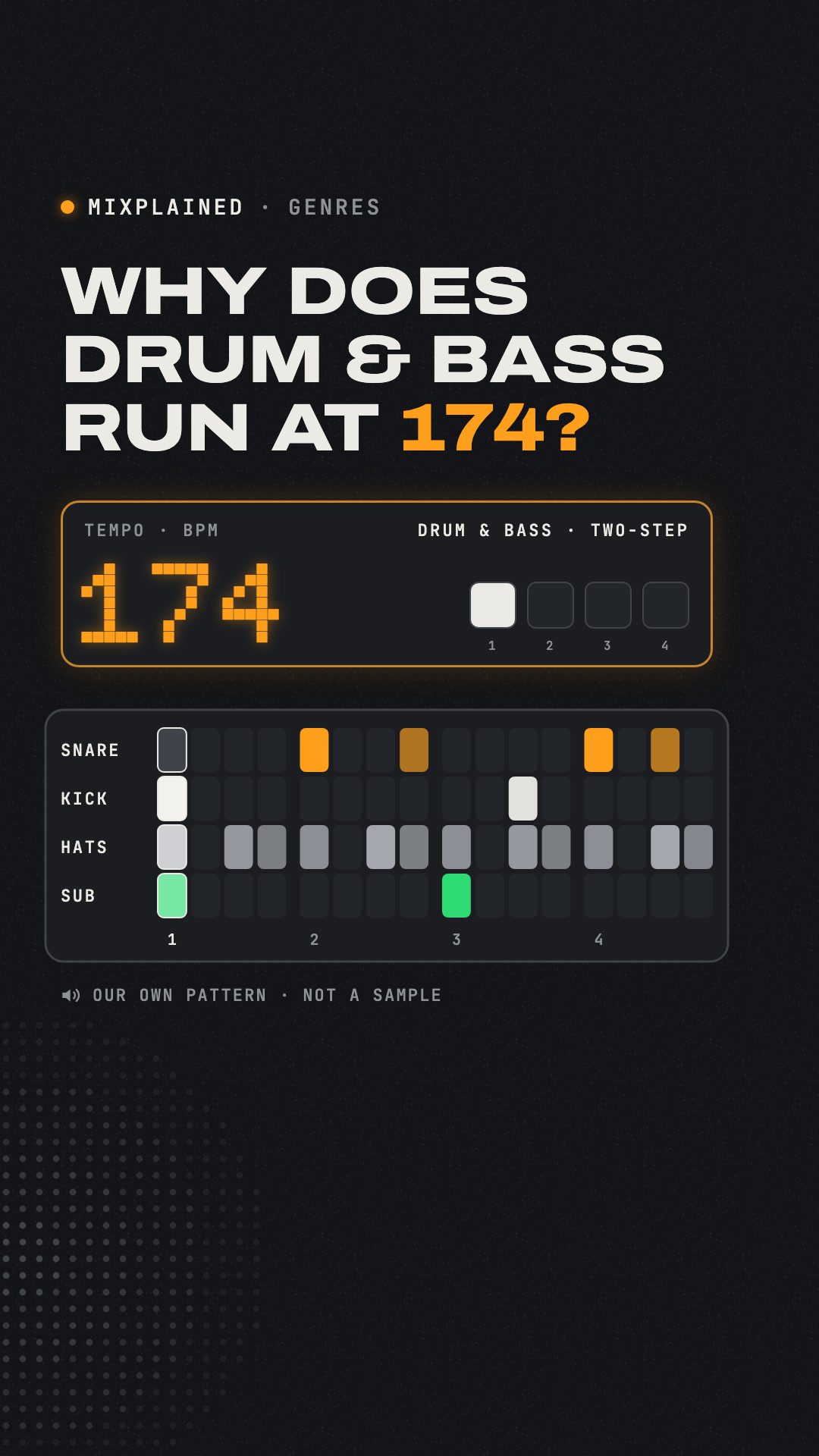
Why drum & bass runs at 174 BPM: sped-up funk breaks climbed from about 150 to 178, the scene tried to slow down, and the bass often moves at half speed – 87, a dub tempo.
174 for the drums. 87 for the bass.
Facts
- Drum & bass grew out of UK breakbeat hardcore and jungle in the early 1990s, built on sampled funk and soul drum breaks. The most famous is the Amen break: a four-bar drum solo by Gregory Coleman on The Winstons' 1969 B-side “Amen, Brother”.
- UK producers kept speeding the breaks up: about 150 BPM by late 1992, around 160 for most jungle by 1993, mostly 170–180 since the mid-1990s – and up to 176–178 by the mid-2000s.
- In 2005 DJ Zinc described a meeting of drum & bass people who wanted to slow the music back to about 168 – and said no one made slower tunes. In 2006 Fabio said it was still “running at 175”. Today 174 is a common tempo.
- The bass often moves at half the tempo of the breaks. At 174 BPM that is 87 (computed), inside the 60–90 BPM range Ableton gives as typical for dub.
- That came from reggae: hardcore and jungle put dub-style bass under breaks running at about twice reggae's pace. Omni Trio's Rob Haigh in 1994: it gives “the illusion that the tune is running at 160 bpm and 80 bpm at the same time”.
- A half-time beat slows the feel by moving the snare to beat 3. Drum & bass usually keeps the snare on 2 and 4 at full speed and lets the bass carry the slow tempo.
Sources
- Wikipedia: Drum and bass (Tempo section) · Wikipedia checked 7 October 2026
- Wikipedia: Jungle music · Wikipedia checked 7 October 2026
- Christodoulou: Bring the Break-Beat Back! Authenticity and the Politics of Rhythm in Drum ‘n’ Bass (Dancecult 12(1), 2020) · Dancecult checked 7 October 2026
- Christodoulou: Rumble in the Jungle – City, Place and Uncanny Bass (Dancecult 3(1), 2011) · Dancecult checked 7 October 2026
- Simon Reynolds: Technical Ecstasy (The Wire #105, November 1992; republished as Hardcore Continuum #1) · The Wire checked 7 October 2026
- Simon Reynolds: Above The Treeline (The Wire #127, September 1994; republished as Hardcore Continuum #2) · The Wire checked 7 October 2026
- Simon Reynolds: 2 Steps Back (The Wire #166, December 1997; republished as Hardcore Continuum #5) · The Wire checked 7 October 2026
- Red Bull Music Academy: Zinc lecture (Seattle 2005) · Red Bull Music Academy checked 7 October 2026
- Red Bull Music Academy: Fabio lecture (Melbourne 2006) · Red Bull Music Academy checked 7 October 2026
- Red Bull Music Academy Daily: Nightclubbing – Fabio and Grooverider's Rage (2015) · Red Bull Music Academy checked 7 October 2026
- Library of Congress: National Recording Registry 2026 – “Amen, Brother”, The Winstons (1969) · Library of Congress checked 7 October 2026
- BBC News: Six seconds that shaped 1,500 songs (2015) · BBC checked 7 October 2026
- Mixmag: The 20 best tracks that sample the Amen break (2018) · Mixmag checked 7 October 2026
- Ableton Learning Music: Tempo and genre · Ableton checked 7 October 2026
- Attack Magazine: Beat Dissected – Raw Drum & Bass (2012) · Attack Magazine checked 7 October 2026
- Native Instruments: How to produce a drum and bass track (2023) · Native Instruments checked 7 October 2026
- Splice: What is drum and bass music? History, artists and subgenres (2025) · Splice checked 7 October 2026
- Red Bull: These are the drum 'n' bass sub-genres that you need to know (2018, archived copy) · Red Bull checked 7 October 2026
- Red Bull: A 10-step guide on how to remix drum 'n' bass (2019, archived copy) · Red Bull checked 7 October 2026
All sound is original: synthesised for the episode, no samples, no licensed tracks. The narrator’s voice is AI-generated. General information. Features differ by software, player and version – check your own manual. Read how facts are checked and corrected.
Script
Why does drum & bass run at 174? It started with sampled funk breaks, like the 1969 Amen break. UK producers sped them up: about 150 by late 1992, 160 by 1993. By the mid-2000s it reached 176, even 178. The scene even met to slow it down. It didn't stick: 174 is common today. But mute the drums, and listen to the bass. It often moves at half speed. So 174 can feel like 87. 87 is a dub tempo. Jungle put reggae-style bass under breaks running twice as fast. 174 for the drums. 87 for the bass.
Sources last checked 7 October 2026.