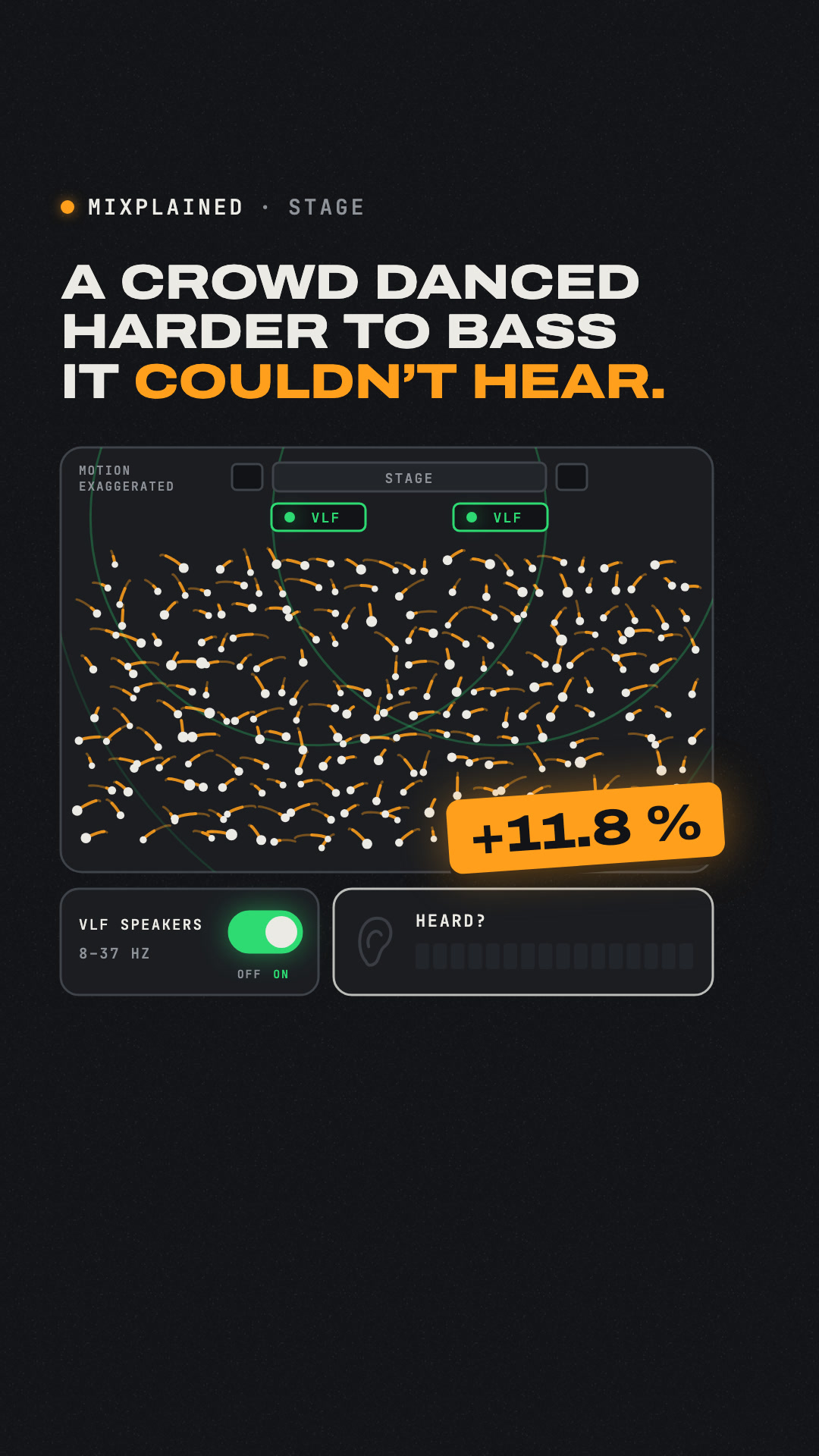
At a 2022 concert, a crowd moved 11.8% more while speakers playing 8–37 Hz were on – and in a later test, listeners couldn't tell. Why bass is felt as well as heard: 7-metre waves, a shaking chest, touch and balance.
Your ears hear the bass. Your body dances to it.
Facts
- A wave's length is its speed divided by its frequency: at 343 m/s, a 50 Hz bass wave is about 6.9 m long (computed) – longer than a person is tall.
- In lab tests with loud low tones (20–50 Hz at 100–110 dB), the skin of the chest and belly measurably vibrated, and how strongly people felt vibration there tracked it. Above 31.5 Hz the chest vibrated about 10 dB more than the belly; the researchers presume the air-filled lungs vibrate easily. One study they cite reports a deaf person sensing low-frequency noise as vibration in the chest.
- The skin's sense of vibration spans roughly 0.4 Hz to over 500 Hz. Its Pacinian channel, the one that feels “vibration”, is most sensitive around 250–300 Hz – well above sub-bass.
- In a 2020 study, 22 people in a parked car heard the same music through sealed earphones with and without a subwoofer stimulating their bodies. With the sub they tapped more forcefully, moved more and rated the groove and their enjoyment higher.
- At a 2022 concert by the electronic duo Orphx at McMaster University's LIVELab, a 106-seat concert lab in Hamilton, Canada, researchers switched very-low-frequency speakers (8–37 Hz) on and off every 2.5 minutes for 55 minutes. Audience members in motion-capture headbands moved 11.8% more on average with them on; in a later test, 17 listeners spotted the difference 49.8% of the time (chance). The researchers suggest touch and/or the balance (vestibular) system carried the effect.
- Front rows can get extremely loud: a study of live events found peaks above 140 dBC and 5-minute averages of 120–130 dBC in front rows when ground-based subwoofers were used – above all current regulations.
Sources
- Cameron, Dotov, Flaten, Bosnyak, Hove & Trainor: Undetectable very-low frequency sound increases dancing at a live concert (Current Biology 32(21), R1222–R1223, 2022) · Current Biology checked 8 October 2026
- Takahashi, Yonekawa, Kanada & Maeda: A pilot study on the human body vibration induced by low frequency noise (Industrial Health 37, 28–35, 1999) · Industrial Health checked 8 October 2026
- Hove, Martinez & Stupacher: Feel the bass – music presented to tactile and auditory modalities increases aesthetic appreciation and body movement (Journal of Experimental Psychology: General 149(6), 1137–1147, 2020) · J. Exp. Psychol. checked 8 October 2026
- University Physics Volume 1, 17.2 Speed of Sound · OpenStax checked 8 October 2026
- Takahashi, Kanada, Yonekawa & Harada: A study on the relationship between subjective unpleasantness and body surface vibrations induced by high-level low-frequency pure tones (Industrial Health 43, 580–587, 2005) · Industrial Health checked 8 October 2026
- Takahashi: A study on the contribution of body vibrations to the vibratory sensation induced by high-level, complex low-frequency noise (Noise & Health 13(50), 2–8, 2011) · Noise & Health checked 8 October 2026
- Remache-Vinueza et al.: Audio-tactile rendering – a review on technology and methods to convey musical information through the sense of touch (Sensors 21(19), 6575, 2021) · Sensors (MDPI) checked 8 October 2026
- Bolanowski, Gescheider, Verrillo & Checkosky: Four channels mediate the mechanical aspects of touch (JASA 84(5), 1680–1694, 1988) · JASA checked 8 October 2026
- McMaster University: LIVELab · McMaster University checked 8 October 2026
- ProSoundWeb: Adam Hill – Live event sound levels, rising above the “insidious undercurrent of aural incapacitance” (2022) · ProSoundWeb checked 8 October 2026
Front rows near ground-stacked subs can exceed every current sound-level limit: wear earplugs.
All sound is original: synthesised for the episode, no samples, no licensed tracks. The narrator’s voice is AI-generated. General information. Features differ by software, player and version – check your own manual. Read how facts are checked and corrected.
Script
A crowd danced harder to bass it couldn't hear. At 50 Hz, one bass wave is about 7 metres – four of you, head to toe. Loud enough, it shakes your chest – more than your belly. Probably your lungs: balloons of air. Go lower. At a 2022 gig in Canada, researchers switched speakers for 8 to 37 Hz on and off. Speakers on: the crowd moved 11.8% more. Could people tell? In a later test: 49.8% right. A coin flip. The researchers think touch or balance picked it up, not hearing. Your ears hear the bass. Your body dances to it.
Sources last checked 8 October 2026.