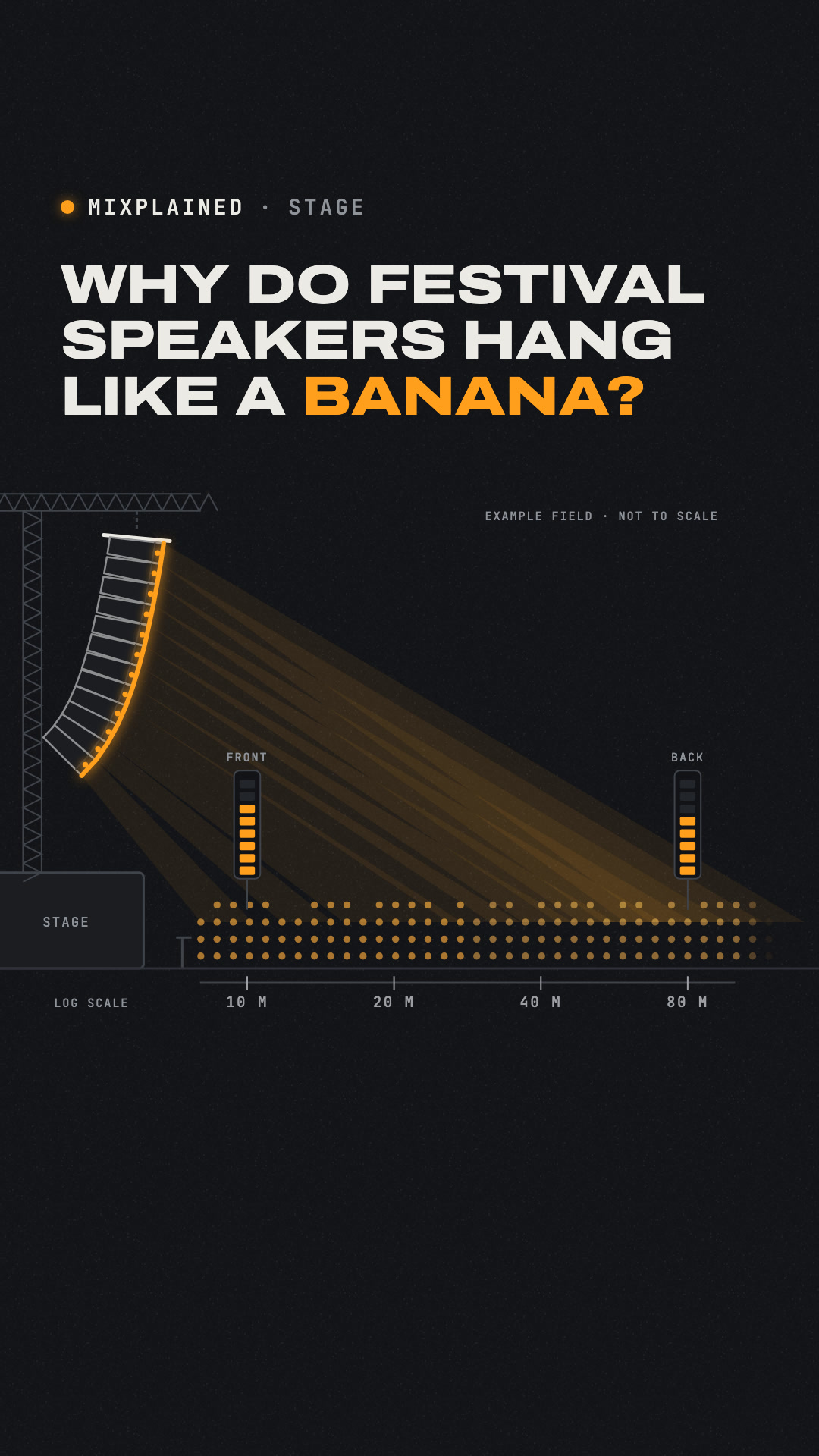
Why festival line arrays hang in a curve: straight top boxes team up to reach the back, angled lower boxes cover the front, so front and back can end up about 6 dB apart instead of 18 – a curve computed for each field in software.
Straight for the back. Bent for the front.
Facts
- A single loudspeaker spreads its sound like a growing sphere: about 6 dB quieter each time the distance doubles, so a listener eight times farther away hears about 18 dB less (computed with the inverse-square law).
- Line array boxes hang close together so they couple into one tall source with a narrow vertical beam. Close to it, a line loses only about 3 dB per doubling, but how far that near field reaches depends on frequency and array length; farther out it is back to about 6 dB, and below roughly 100 Hz a practical hang is too short to act as a line. Meyer Sound has called the “cylindrical wave” a marketing concept.
- The J or “banana”: the nearly straight top boxes overlap and team up to throw to the back, while the lower boxes are angled further apart so each covers a patch nearer the stage. d&b's GSL boxes are set 0–7° apart (KSL 0–10°) and can cover throws of up to 100 m.
- In system engineer Merlijn van Veen's worked example, the back of the audience is eight times farther away than the front – 18 dB by distance alone. Splays growing from about 1° at the top to 8° or more at the bottom bring the predicted drop across the audience to about 6 dB.
- Each hang is designed for its venue in prediction software: d&b says its line arrays must be designed in ArrayCalc, L-Acoustics launched Soundvision in 2004, and festival coverage predictions are often made up to six months ahead and submitted to local authorities for the licence.
- The modern touring line array dates from 1992, when L-Acoustics founder Christian Heil introduced his Wavefront Sculpture Technology theory and the V-DOSC system; line arrays themselves were described decades earlier by Harry Olson.
Sources
- Sound On Sound: Line Arrays Explained – the science and the magic (David Mellor, March 2006) · Sound On Sound checked 7 October 2026
- Merlijn van Veen: Cylindrical Waves – Hyped or Not? (28 Dec 2021; Live Sound International, Feb 2023) · Merlijn van Veen checked 7 October 2026
- Meyer Sound: Line Arrays – Theory, Fact and Myth (technical report, 2002) · Meyer Sound checked 7 October 2026
- d&b audiotechnik: GSL8/GSL12 Manual 1.6 · d&b audiotechnik checked 7 October 2026
- d&b audiotechnik: TI 385 – d&b Line array design 10.10 · d&b audiotechnik checked 7 October 2026
- d&b audiotechnik: ArrayCalc simulation software · d&b audiotechnik checked 7 October 2026
- d&b audiotechnik: ArrayCalc V8 – ArrayProcessing technical white paper · d&b audiotechnik checked 7 October 2026
- d&b audiotechnik: A staggering d&b system supports World Youth Day 2016 · d&b audiotechnik checked 7 October 2026
- L-Acoustics: Discover L-Acoustics (company timeline) · L-Acoustics checked 7 October 2026
- Wikipedia: L-Acoustics · Wikipedia checked 7 October 2026
- Wikipedia: Line array · Wikipedia checked 7 October 2026
- Sound On Sound: Jon Burton – Outdoor sounds, engineering sound for festival events (2012) · Sound On Sound checked 7 October 2026
Example rig and figures: every hang is designed and measured for its own field.
All sound is original: synthesised for the episode, no samples, no licensed tracks. The narrator’s voice is AI-generated. General information. Features differ by software, player and version – check your own manual. Read how facts are checked and corrected.
Script
Why do festival speakers hang like a banana? One box fades about 6 dB each time distance doubles: eight times farther, 18 dB quieter. Stack the boxes tight and they couple into one tall source. Up close, a line loses only about 3 dB per doubling. Farther out, 6 again. The trick is the bend: straight top boxes team up for the back, angled lower boxes take nearer zones. About 1° between the top boxes, 8° or more at the bottom. Front and back can end up about 6 dB apart, not 18. Each banana is computed in software, often months ahead: a map of its crowd. Straight for the back. Bent for the front.
Sources last checked 7 October 2026.