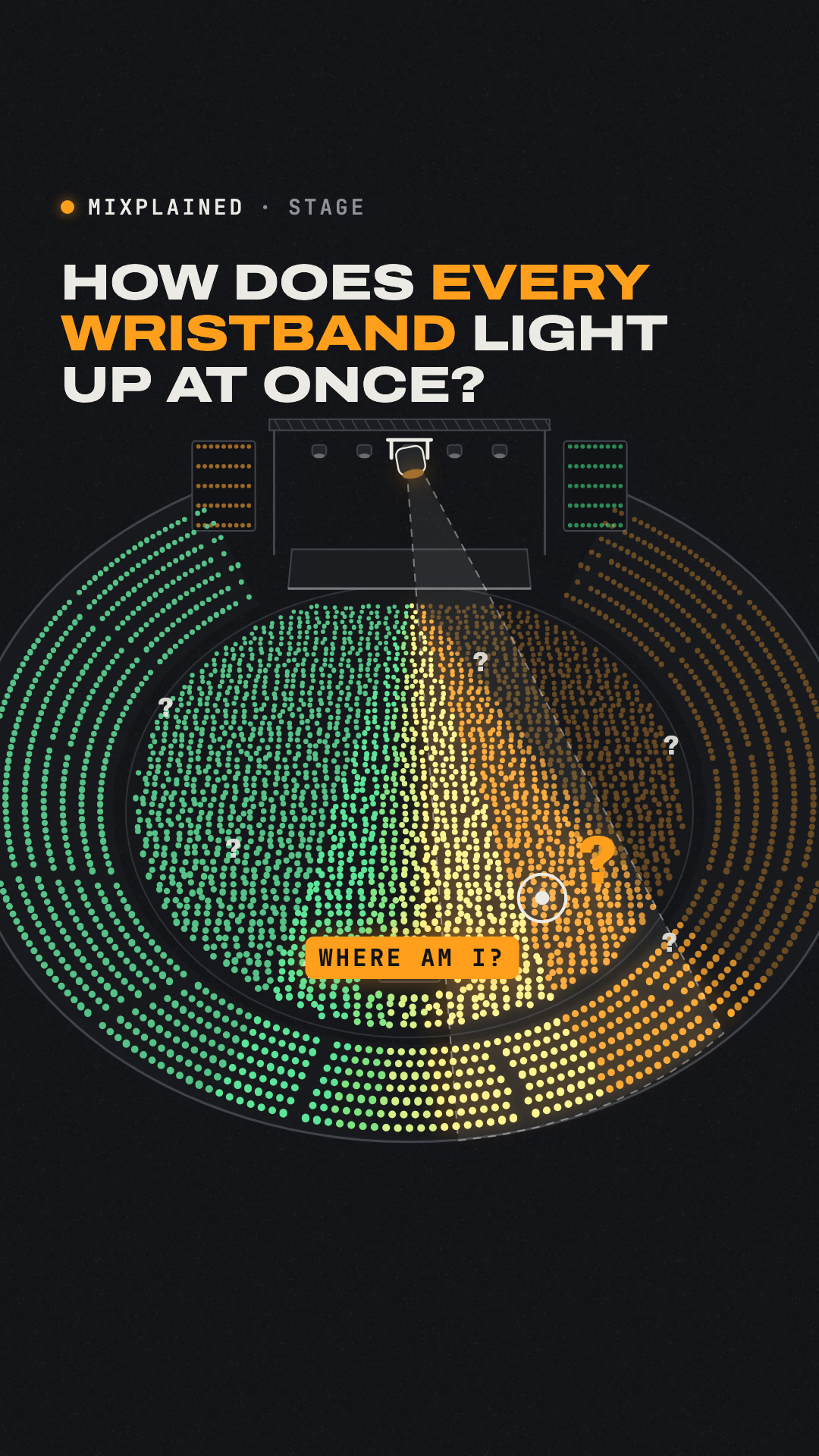
Coldplay's first LED wristbands ran on timers, then radio. Their newer ones listen for infrared: a remote-control receiver in every band, the lighting rig as the remote, aimed beams painting waves and hearts. Collected at the exit, they're reused – and every city gets a return score.
The lighting rig is a giant infrared remote – and you're one of its pixels.
Facts
- The first Xylobands lit up Coldplay's Mylo Xyloto launch show in Madrid on 6 October 2011. They ran on timers, so each had to be programmed individually to go off at the same moment; a radio-controlled version followed for the tour, flashing in time to the music by remote control from the sound desk.
- On the Music of the Spheres tour, Coldplay's PixMob wristbands are commanded by infrared, light you can't see. A 2023 report counted 48 PixMob infrared washes and eight infrared moving heads, run from the same grandMA3 console as the rest of the lights. PixMob also makes radio (RF) bands.
- PixMob says the bands “have no clue where they are in the stadium” when they're handed out at the gate. A teardown of one found an ordinary remote-control infrared receiver inside; bands that miss the signal simply stay dark – “like the lighting rig is a massive remote control pointed at the crowd”.
- Aimed beams paint the crowd: a moving head sweeps waves of colour across the audience, and infrared shone through a metal mask (a gobo) draws shapes such as the hearts on Coldplay's tour. During “Yellow” the whole stadium lights up yellow. PixMob calls each fan a “pixel” in a human-resolution screen.
- The bands are collected at the exit, sterilised and reused. Coldplay says this cut wristband production by 80%, with an average return and re-use rate of 86% (June 2024 update).
- Each city's return rate goes on a leaderboard shown at the concert. Reported rates include Tokyo 97% and Copenhagen 96%; in April 2025 Seoul reached 99%, reported as the tour's record.
Sources
- PixMob: Coldplay – Music of the Spheres World Tour · PixMob checked 16 October 2026
- PixMob: Our Effects · PixMob checked 16 October 2026
- LSi Online: PixMob enhances Coldplay fan experience (16 Jun 2023) · LSi Online checked 16 October 2026
- Gough's Tech Zone: Teardown: Pixmob LED Wristband (Aurora v1.7) (14 Jan 2025) · Gough Lui checked 16 October 2026
- TPi: A Specialz Summer for Xylobands (8 Dec 2016) · TPi checked 16 October 2026
- Hillside Product Design: Xylobands case study · Hillside Product Design checked 16 October 2026
- Xyloband · Wikipedia checked 16 October 2026
- Coldplay: Music of the Spheres World Tour – Sustainability · Coldplay checked 16 October 2026
- Coldplay: Tour Emissions Update 2024 (3 Jun 2024) · Coldplay checked 16 October 2026
- The Korea Times: Seoul tops Coldplay's LED wristband return rate in world tour (25 Apr 2025) · The Korea Times checked 16 October 2026
- Taiwan News: ‘Music of the Spheres’ tour promotes sustainability through recycling of LED wristbands, electricity-generating bicycles (13 Nov 2023) · Taiwan News checked 16 October 2026
- ScandAsia: Coldplays’ Wristband Recycling Leaderboard: Copenhagen at the top, Jakarta at the bottom (14 Feb 2024) · ScandAsia checked 16 October 2026
- SAYS: 1 Out Of 10 Malaysians Didn’t Return Their Wristbands After Coldplay’s Concert In KL (8 Feb 2024) · SAYS checked 16 October 2026
All sound is original: synthesised for the episode, no samples, no licensed tracks. The narrator’s voice is AI-generated. General information. Features differ by software, player and version – check your own manual. Read how facts are checked and corrected.
Script
How does every wristband light up at once? None of them knows where it is. Coldplay's first ones, in 2011, ran on timers, each programmed one by one. Then came radio: one signal, every band. Their newer bands listen for infrared: light you can't see. Inside is an ordinary remote-control receiver. The lighting rig is the remote. Only bands the beam hits change, so a sweep becomes a wave. Through a metal mask, it draws a heart across the crowd. They're collected at the exit and reused, cutting wristband production by 80 percent. Every city gets a return score. In Seoul, 99 percent came back.
Sources last checked 16 October 2026.