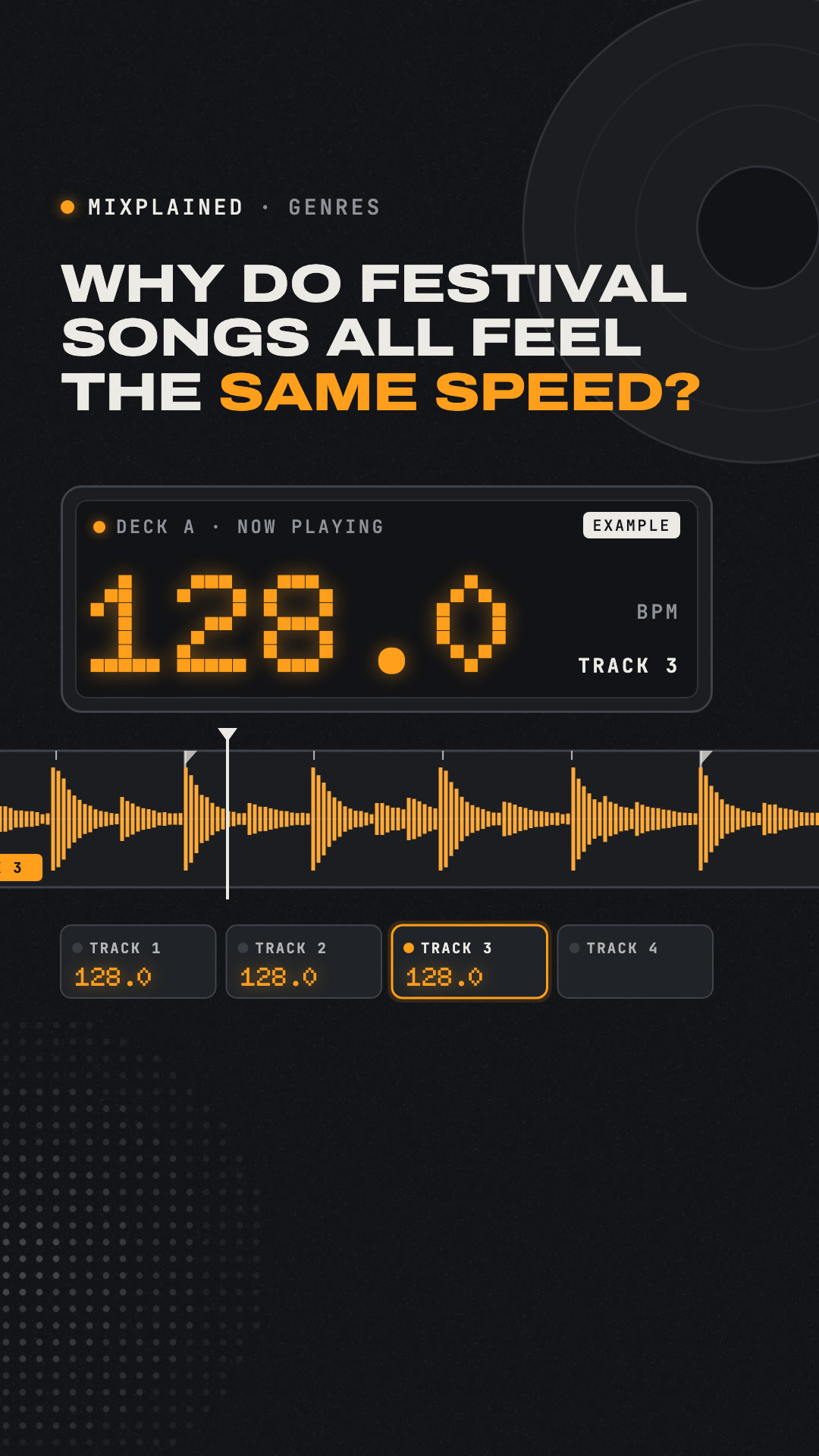
Why festival songs feel the same speed: DJs match each song's tempo, the classic turntable only stretches a record 8 %, ten years of dance charts peaked at 128 BPM – and people step about twice a second, yet the charts dip just below that pace.
Dance music sits at 128: a notch above the two-steps-a-second pace of walking.
Facts
- In ten years of Scandinavian dance charts (1998–2008: 19,577 weekly entries reported by club DJs in Sweden, Finland and Norway), the tempo peak stayed at 128 BPM. 128 alone made up 11.3 % of entries and 125–130 BPM about 44 %. Summer songs averaged 123.9 BPM, winter songs 124.4. In a 2015 Beatport sample, progressive house and electro house both had a median of 128.
- DJs blend songs by matching their tempo; in one study of DJ mixes, the median tempo change from one song to the next was about 0.1 BPM. The classic club turntable, Technics' SL-1200MK2 (1979), changes speed by up to ±8 %, and the pitch moves with it: from 128, that reaches about 118–138 BPM (computed). Pioneer's 1994 CDJ-500 manual says the pitch shift makes vocals “unnatural”; today's players go to ±16 % or more and can lock the key.
- Over a 10-hour day of normal activity, 20 people's steps settled at about 2 per second (2 Hz, SD 0.13) – 120 a minute – with no sign of a link to age, height or weight (MacDougall & Moore, 2005). Older textbooks put our natural pace at about 100 a minute; newer tapping tests land between 120 and 130. In a 2002 Ghent University study, 34 musically trained people tapping at a comfortable rate averaged 467 ms between taps – about 128 a minute (computed) – though answers ranged from 191 to 953 ms.
- Just below that pace, the charts dip: only 4.7 % of entries sat between 110 and 120 BPM. Musicologist Dirk Moelants calls 128 “only slightly above” the 2 Hz of natural movement and “perfect for a somewhat ‘excited’ movement”; in a walking study he co-wrote, people walked fastest to music around 130 BPM.
- Genres far from 128 change the dance, Moelants suggests: trance, around 140, goes with smaller movements; gabber, the fastest hardcore techno, with tiny fast footwork under slower arm movements; hip-hop and R&B, around 95, with circular moves. In a 2018 study where 266 people tapped along to dance tracks, most clips of techno and trance got a single answer; in drum & bass and dubstep, fewer than 38 % did.
Sources
- Moelants: Hype vs. natural tempo – a long-term study of dance music tempi (10th International Conference on Music Perception and Cognition, 2008) · ICMPC checked 9 October 2026
- Moelants: Dance music, movement and tempo preferences (5th Triennial ESCOM Conference, Hanover, 2003, pp. 649–652) · ESCOM checked 9 October 2026
- Moelants: Preferred tempo reconsidered (7th International Conference on Music Perception and Cognition, Sydney, 2002, pp. 580–583; archived PDF) · ICMPC checked 9 October 2026
- MacDougall & Moore: Marching to the beat of the same drummer – the spontaneous tempo of human locomotion (Journal of Applied Physiology 99: 1164–1173, 2005) · J Appl Physiol checked 9 October 2026
- van Noorden & Moelants: Resonance in the perception of musical pulse (Journal of New Music Research 28(1): 43–66, 1999) · JNMR checked 9 October 2026
- Kell & Tzanetakis: Empirical analysis of track selection and ordering in electronic dance music using audio feature extraction (ISMIR 2013) · ISMIR checked 9 October 2026
- Knees et al.: Two data sets for tempo estimation and key detection in electronic dance music annotated from user corrections (ISMIR 2015) · ISMIR checked 9 October 2026
- Audio Heritage: Technics SL-1200MK2 catalogue data (in Japanese) · Audio Heritage checked 9 October 2026
- Technics Japan: SL-1200 series history (SL-1200M7L site, in Japanese) · Technics checked 9 October 2026
- Technics: Direct Drive Turntable System SL-1200MK7 · Technics checked 9 October 2026
- Pioneer: CDJ-500 Compact Disc Player, Operating Instructions (1994; scan) · Pioneer checked 9 October 2026
- AlphaTheta (Pioneer DJ): CDJ-3000 Instruction Manual (DRI1586-A), p. 47 · AlphaTheta checked 9 October 2026
- Wikipedia: Beatmatching · Wikipedia checked 9 October 2026
- Wikipedia: Disc jockey · Wikipedia checked 9 October 2026
- Schreiber & Müller: A crowdsourced experiment for tempo estimation of electronic dance music (ISMIR 2018) · ISMIR checked 9 October 2026
All sound is original: synthesised for the episode, no samples, no licensed tracks. The narrator’s voice is AI-generated. General information. Features differ by software, player and version – check your own manual. Read how facts are checked and corrected.
Script
Why do festival songs all feel the same speed? In a DJ set, they often are: the DJ matches each song to the last. But the classic club turntable only goes 8 percent faster or slower, and the pitch moves too. So the next song had to start close. And most do: ten years of Scandinavian dance charts peaked at 128 beats a minute. Your body may play a part: over a whole day, people's steps settle at about two a second. Yet just below that pace, the charts dip: under 5 percent sat between 110 and 120. Dance music runs a notch faster. And summer's songs ran no faster than winter's.
Sources last checked 9 October 2026.