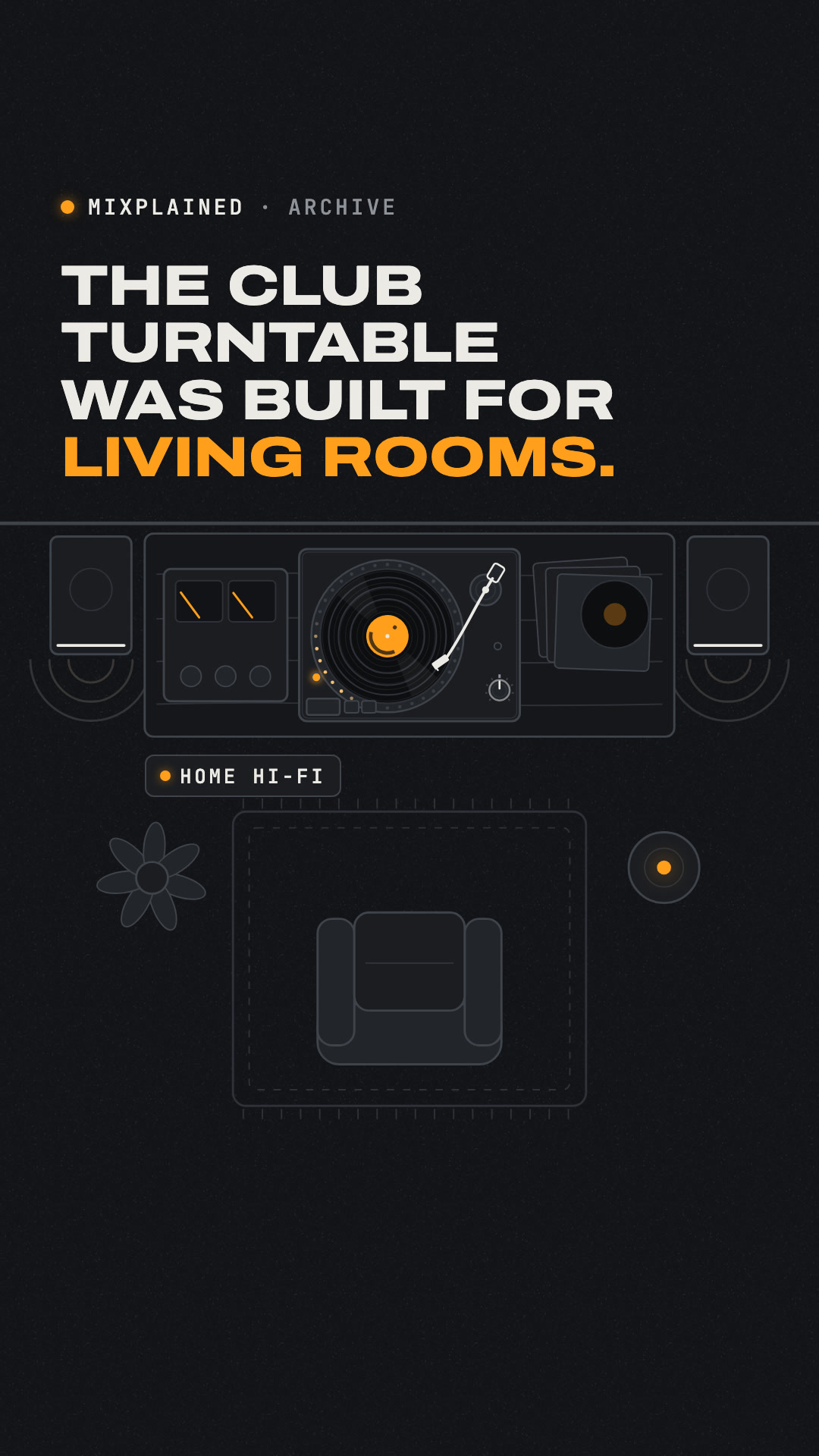
The Technics SL-1200 began in 1972 as home hi-fi. DJs turned its speed-trim knob into a beat-matching tool – and in 1979 Technics kept it, as a ±8 % slider, even after quartz lock made it unnecessary.
Built for living rooms. Rebuilt for DJs.
Facts
- Technics (Matsushita, now Panasonic) launched the SL-1200 in October 1972 for the home hi-fi market. Technics says its turntables “were designed as hi-fi products for audiophiles originally”.
- It is direct drive: the motor turns the platter itself, with no belt. Technics' 1972 description says it was fully up to speed within half a turn; the 1979 MK2 was rated at 1.5 kg·cm starting torque and 0.7 s from standstill to 33⅓ rpm – the same 0.7 s as today's MK7.
- DJs in US discos adopted it in the 1970s. Technics says its engineers were “astonished” to find it there during US market research, and that DJs asked them not to change it. A 1998 XXL feature credits a team led by engineer Shuichi Obata.
- The original's pitch knob was there to fine-tune the motor's speed; DJs used it to match the BPM of records. The 1979 MK2's quartz lock made that correction unnecessary, but Technics kept the control as a ±8 % slider – calling the MK2 “the first turntable specifically developed for use in discos”.
- It became, in Technics' words, “the de facto standard turntable in the club scene”; by Technics' count about 3.5 million SL-1200s were made by 2007. In October 2010 Panasonic said it would end production, citing falling demand and hard-to-source analogue parts.
- The line returned in 2016 with the SL-1200G and the SL-1200GAE (1,200 units worldwide); the DJ model SL-1200MK7 followed in 2019, with a ±8 % / ±16 % pitch slider.
Sources
- Technics: History of the SL-1200, an icon of music culture · Technics checked 7 October 2026
- Technics Japan: SL-1200 series history (SL-1200M7L product site) · Technics checked 7 October 2026
- Technics: Direct Drive Turntable System SL-1200MK7 (features and specs) · Technics checked 7 October 2026
- Panasonic USA: Technics SL-1200MK2 specifications (archived 15 Jun 2004) · Panasonic checked 7 October 2026
- Audio Heritage (Japan): Technics SL-1200 (1972) catalogue specifications · Audio Heritage checked 7 October 2026
- Audio Heritage (Japan): Technics SL-1200MK2 catalogue specifications · Audio Heritage checked 7 October 2026
- MusicTech: Studio icons – Technics SL-1200 (John Pickford) · MusicTech checked 7 October 2026
- Wired: Six machines that changed the music world (Pat Blashill, May 2002) · Wired checked 7 October 2026
- Wired: Farewell, SL-1200 – Panasonic scratches iconic Technics turntable (Charlie Sorrel, 1 Nov 2010) · Wired checked 7 October 2026
- The Vinyl Factory: How Technics SL-1200 became the world's most popular turntable (Paul Rigby, 2015) · The Vinyl Factory checked 7 October 2026
- Brian Coleman: The Technics 1200 – Hammer of the Gods (XXL, Fall 1998; republished on Medium 2016) · XXL checked 7 October 2026
- Ableton Live manual: Audio clips, tempo and warping – Re-Pitch mode · Ableton checked 7 October 2026
- Tokyo Reporter: Dead spin – Panasonic discontinues Technics analog turntables (28 Oct 2010) · Tokyo Reporter checked 7 October 2026
- Ars Technica: The legendary Technics SL-1200 turntable is back and better than ever (Mark Walton, 6 Jan 2016) · Ars Technica checked 7 October 2026
- Gizmodo: The Technics 1200 turntable is back (Andrew Liszewski, 5 Jan 2016) · Gizmodo checked 7 October 2026
- The Vinyl Factory: Technics unveils new SL-1200 MK7 turntable (7 Jan 2019) · The Vinyl Factory checked 7 October 2026
All sound is original: synthesised for the episode, no samples, no licensed tracks. The narrator’s voice is AI-generated. General information. Features differ by software, player and version – check your own manual. Read how facts are checked and corrected.
Script
The club turntable was built for living rooms. Technics launched the SL-1200 in 1972, as home hi-fi. Its motor spins the platter directly: full speed in half a turn, and it holds it. DJs in US discos took it over. Its makers were astonished. Its pitch knob fine-tuned the motor's speed. DJs used it to match beats. In 1979, quartz lock made that knob unnecessary. Technics kept it anyway, as a slider: ±8 %. Push it up: faster and higher. The club standard: about 3.5 million made. Stopped in 2010. Back in 2016. Built for living rooms. Rebuilt for DJs.
Sources last checked 7 October 2026.