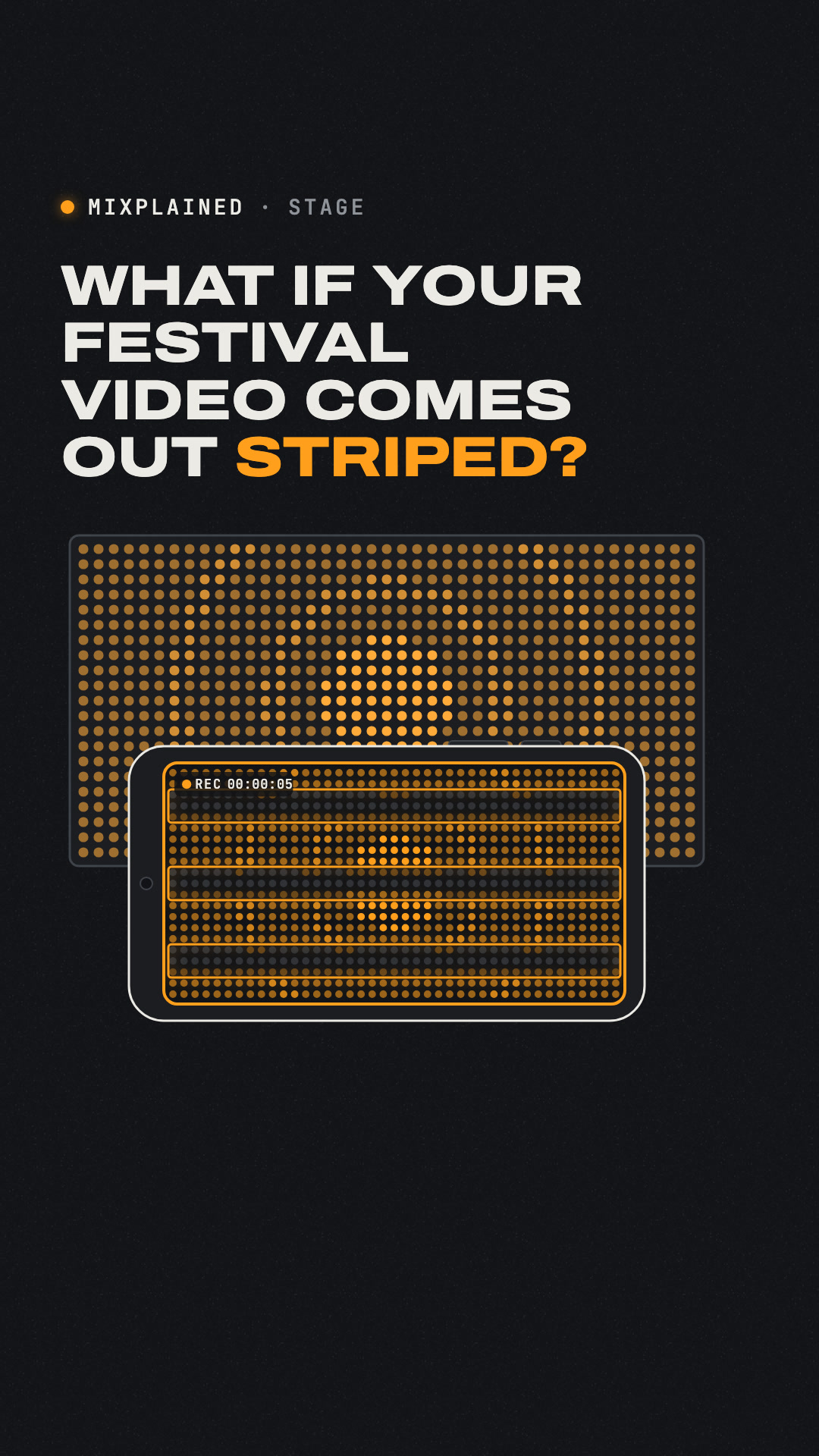
Why phone videos of a festival LED wall come out with rolling black bands: the wall blinks thousands of times a second, row by row, and a phone's rolling shutter samples it line by line. Pros genlock the wall; you can slow the shutter.
Fast shutter, stripes. Slow shutter, the show.
Facts
- LED video walls don't glow steadily: they redraw the picture at a refresh rate – typically 1,920, 3,840 or 7,680 times a second (ROE Visual) – and set brightness with PWM, switching the LEDs on and off. Above the flicker-fusion threshold, the eye sees only the average.
- Most panels are multiplexed (“scan”): one driver-chip pin drives several LEDs, one at a time; typical scan rates are 16:1, 11:1 and 8:1. Example: ROE's Black Pearl 2V2 refreshes at 7,680 Hz with 1/8 scan; INFiLED's indoor GXmk2 3.9 mm runs 3,840 Hz at 1/16.
- Most phone cameras use a rolling shutter: the sensor exposes and reads the image line by line. With a short exposure, some lines catch the LEDs on and others off, so dark bands appear – and a camera picks up these scan lines more easily than our eyes do.
- The wall and the camera run on separate clocks, so the bands roll. Pro crews genlock the LED processor to the camera so the dark lines stop moving, then fine-tune the shutter; Brompton's ShutterSync even tunes the wall's refresh to the camera. Higher refresh rates help too: ROE says 7,680 Hz “helps largely to avoid visible scan-lines”.
- At the barrier: in a camera app with a manual shutter, try a slower shutter such as 1/50 s (1/60 s where the mains is 60 Hz). Each line then spans dozens of refresh cycles – about 77 at 3,840 Hz (computed) – which usually fades the bands. It also adds motion blur.
Sources
- ROE Visual: Thesaurus – LED technology for virtual production, xR, film · ROE Visual checked 7 October 2026
- ROE Visual: Things you need to know about LED when starting in virtual production · ROE Visual checked 7 October 2026
- ROE Visual: Black Pearl 2V2 (BP2V2) product page and specifications · ROE Visual checked 7 October 2026
- ROE Visual: The crucial role of LED panel quality in display technology · ROE Visual checked 7 October 2026
- INFiLED: GXmk2 series rental LED video wall – specifications · INFiLED checked 7 October 2026
- Brompton Technology: Genlock (Tessera feature) · Brompton Technology checked 7 October 2026
- Brompton Tessera user manual: Genlock settings · Brompton Technology checked 7 October 2026
- Brompton Technology: ShutterSync (Tessera feature) · Brompton Technology checked 7 October 2026
- Brompton Tessera user manual: ShutterSync · Brompton Technology checked 7 October 2026
- Brompton Technology: Operating Modes (Tessera feature) · Brompton Technology checked 7 October 2026
- Megapixel: GhostFrame – in-camera visual effects (white paper, 2025) · Megapixel checked 7 October 2026
- Android Developers: CaptureResult.SENSOR_ROLLING_SHUTTER_SKEW · Android Developers checked 7 October 2026
- Android Developers: CaptureRequest.CONTROL_AE_ANTIBANDING_MODE · Android Developers checked 7 October 2026
- Sony Semiconductor Solutions: Pregius – global shutter and rolling shutter · Sony Semiconductor checked 7 October 2026
- Kuo, Pannuto, Hsiao & Dutta: Luxapose – indoor positioning with mobile phones and visible light (ACM MobiCom 2014) · ACM MobiCom checked 7 October 2026
- Wikipedia: Pulse-width modulation (power delivery) · Wikipedia checked 7 October 2026
- Wikipedia: Flicker fusion threshold · Wikipedia checked 7 October 2026
- Wikipedia: Genlock · Wikipedia checked 7 October 2026
- Sony α7 IV (ILCE-7M4) Help Guide: Anti-flicker Set. · Sony checked 7 October 2026
- Blackmagic Design: Blackmagic Camera app (iOS and Android) · Blackmagic Design checked 7 October 2026
A slower shutter adds motion blur and light. Results vary by wall and phone, so check a test clip.
All sound is original: synthesised for the episode, no samples, no licensed tracks. The narrator’s voice is AI-generated. General information. Features differ by software, player and version – check your own manual. Read how facts are checked and corrected.
Script
What if your festival video comes out striped? That LED wall isn't steady. It's blinking, thousands of times a second. Its rows take turns: one driver pin can feed 16 LEDs. Your eyes average it. Your phone usually reads it line by line. With a fast shutter, some lines catch the LEDs on, some off. Two clocks, out of step: the dark bands roll. Pro crews lock the wall to the camera: genlock. The bands freeze. You can't. So slow your shutter: try 1/50 in a pro camera app. Now every line catches dozens of blinks, and the stripes fade. Fast shutter, stripes. Slow shutter, the show.
Sources last checked 7 October 2026.