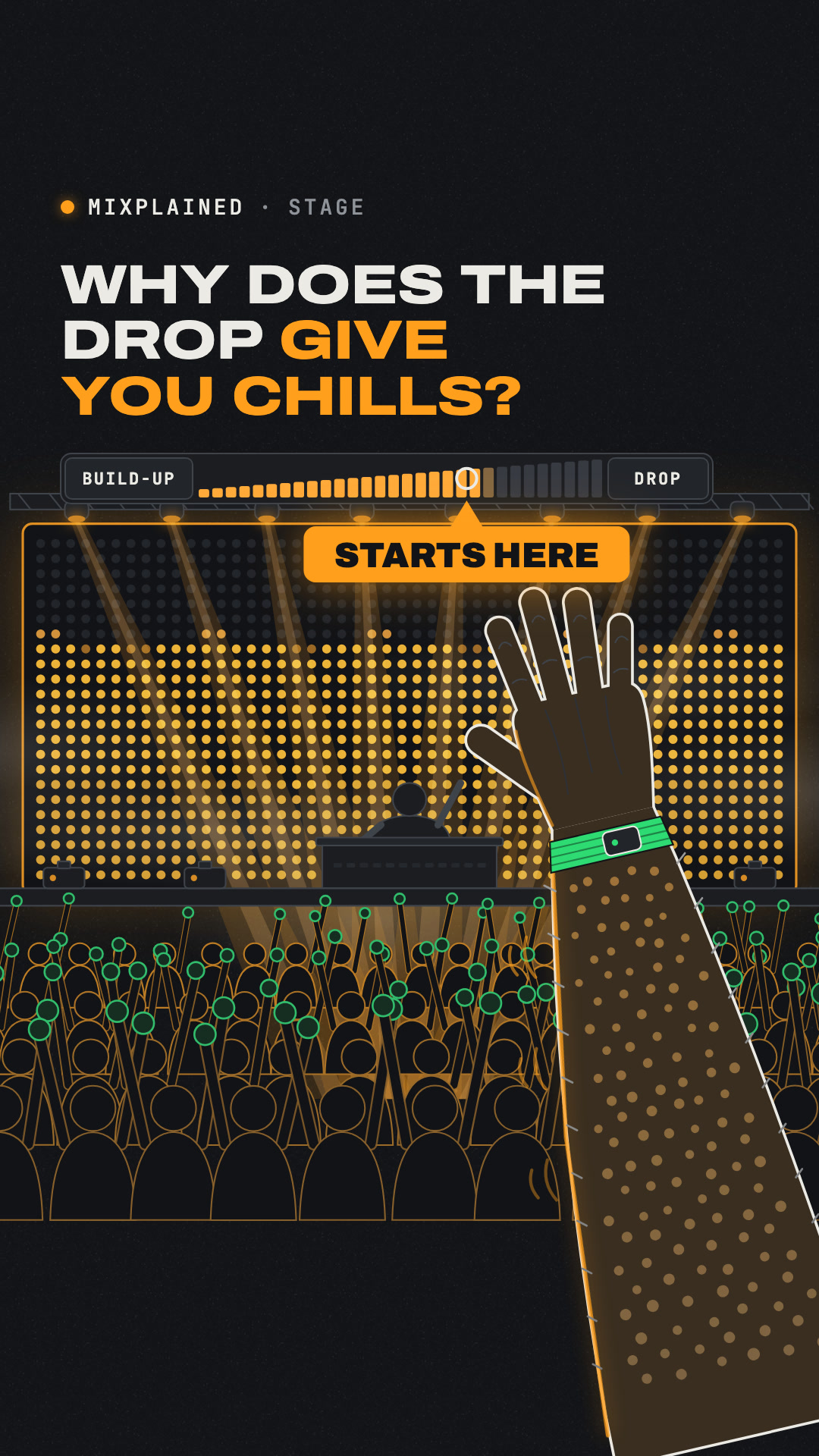
Chills tend to hit when music suddenly gets louder, a new sound comes in or a chord surprises you, and a drop does that on cue. In one brain-scan study, chills came with dopamine release, and a different area was busy in the seconds before: anticipation, which is what a build-up builds.
The build-up isn't just the wait for the drop – it's part of the reward.
Facts
- Chills tend to come with sudden jumps in loudness and crescendos, new instruments or voices coming in, and new or unexpected harmonies (Sloboda 1991; Guhn et al. 2007; Grewe et al. 2007; Bannister 2018; de Fleurian & Pearce 2021).
- An EDM break routine uses the same kinds of changes. In a 2019 lab study, 24 listeners heard four EDM tracks: 25–46% per track reported chills, tingling or goosebumps, they attributed their peak experience to the drop in particular, and skin conductance was significantly higher in the drop sections (Solberg & Dibben).
- In a 2011 brain-scan study, eight listeners (chosen from 217 who answered an advert for people who get chills) released dopamine in the striatum to music that gave them chills. One area, the nucleus accumbens, was most involved during the chills; another, the caudate, in the seconds before them – the anticipation. The more the caudate released, the more chills they reported. Their chill tracks ranged from classical to techno (Salimpoor et al.).
- In a 2019 study of 27 people, the 16 who got chills spent more time in chills after a dopamine precursor (levodopa) than after a dopamine blocker (risperidone), and participants bid more money for songs on levodopa. These were prescription drugs given in a controlled study (Ferreri et al., PNAS).
- Not everyone gets them: estimates range from 55% to 86% of people, and fewer report them in a single lab session (16 of 27 in one study). People who score higher on openness to experience tend to report more of them.
Sources
- Salimpoor, Benovoy, Larcher, Dagher & Zatorre: Anatomically distinct dopamine release during anticipation and experience of peak emotion to music (Nature Neuroscience 14, 2011) · Nature Neuroscience checked 17 October 2026
- Blood & Zatorre: Intensely pleasurable responses to music correlate with activity in brain regions implicated in reward and emotion (PNAS 98/20, 2001) · PNAS checked 17 October 2026
- Harrison & Loui: Thrills, chills, frissons, and skin orgasms – toward an integrative model of transcendent psychophysiological experiences in music (Frontiers in Psychology 5, 2014) · Frontiers in Psychology checked 17 October 2026
- Sloboda: Music structure and emotional response – some empirical findings (Psychology of Music 19/2, 1991; abstract) · Psychology of Music checked 17 October 2026
- Guhn, Hamm & Zentner: Physiological and musico-acoustic correlates of the chill response (Music Perception 24/5, 2007; abstract) · Music Perception checked 17 October 2026
- de Fleurian & Pearce: The relationship between valence and chills in music – a corpus analysis (i-Perception 12/4, 2021) · i-Perception checked 17 October 2026
- Bannister: A survey of musically-induced chills – emotional characteristics and ‘chills moments’ in music (SysMus17 proceedings, 2017; abstract) · SysMus17, Queen Mary University of London checked 17 October 2026
- Bannister: A survey into the experience of musically induced chills – emotions, situations and music (Psychology of Music, 2018; abstract) · Psychology of Music checked 17 October 2026
- Solberg: “Waiting for the bass to drop” – correlations between intense emotional experiences and production techniques in build-up and drop sections of electronic dance music (Dancecult 6/1, 2014) · Dancecult checked 17 October 2026
- Solberg & Dibben: Peak experiences with electronic dance music – subjective experiences, physiological responses, and musical characteristics of the break routine (Music Perception 36/4, 2019; accepted manuscript) · Music Perception checked 17 October 2026
- Ferreri et al.: Dopamine modulates the reward experiences elicited by music (PNAS 116/9, 2019) · PNAS checked 17 October 2026
- Colver: Why do only some people get ‘skin orgasms’ from listening to music? (The Conversation, 2016) · The Conversation checked 17 October 2026
- Colver & El-Alayli: Getting aesthetic chills from music – the connection between openness to experience and frisson (Psychology of Music, 2016; abstract) · Psychology of Music checked 17 October 2026
All sound is original: synthesised for the episode, no samples, no licensed tracks. The narrator’s voice is AI-generated. General information. Features differ by software, player and version – check your own manual. Read how facts are checked and corrected.
Script
Why does the drop give you chills? The answer starts before the drop. Chills tend to hit when music suddenly gets loud, a new sound comes in, or a chord surprises you. A drop does it on cue. EDM listeners in a lab traced their tingles to the drop. In one brain-scan study, chills came with dopamine, a reward chemical. But a different area got busy in the seconds before. Anticipation: exactly what a build-up builds. The more dopamine released there, the more chills they had. So the build-up isn't just the wait. It's part of the reward.
Sources last checked 17 October 2026.